

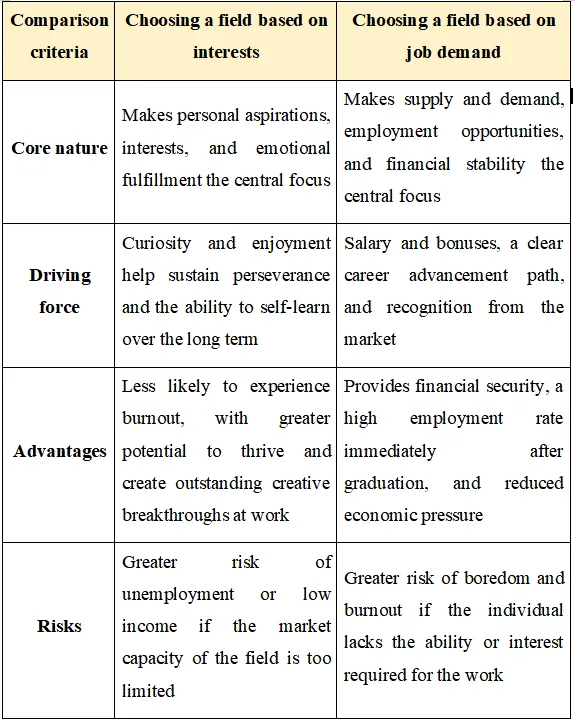
Choosing a field of study at the threshold of high school graduation marks the starting point of an individual's first confrontation between personal ideals and the realities of adult life. At this turning point, high school students often find themselves caught between two seemingly irreconcilable ways of thinking: Should they pursue their interests to live a meaningful life, or choose a field based on market demand to ensure financial stability?

If they focus solely on interests driven by emotion, young people face the risk of unemployment or unstable income after graduation. Conversely, if they simply follow “hot” fields based on popular trends without having a genuine alignment with their abilities and personal aspirations, they may easily experience exhaustion and discouragement over the long term.
Market trends and the risks of short-lived “fads”
Many parents and students tend to place their full trust in current forecasts of labor demand when deciding what to study over the next four to five years. However, the modern labor market, under the influence of the technological revolution and artificial intelligence (AI), is changing at an unpredictable pace.
According to career guidance experts at Tan Tao University, blindly following popular career fields while ignoring personal interests and abilities can lead to serious consequences. A field experiencing a labor shortage at present may become saturated or be replaced by automation by the time students graduate. Choosing a field purely based on “advertised” job stability without genuine interest will undermine the motivation for self-learning, causing students to fall behind even while at university and face the risk of unemployment after graduation because they do not meet the quality standards required by businesses.
In addition to the risk of becoming technologically outdated, choosing a career solely because of high salaries or strong demand can easily lead to burnout and deep dissatisfaction over time. Without curiosity and enjoyment of the work, each working day can become a heavy psychological burden. This lack of motivation reduces productivity, limits creative thinking, and inadvertently closes the door to career advancement within the corporate structure.

The limits of pure passion and the harsh reality of the economy
However, idealizing the phrase “follow your passion” while ignoring the laws of supply and demand in the economy is an equally dangerous trap for high school students. The interests of an 18-year-old student are often temporary, shaped through the lens of media, films, or social media trends rather than tested through real-world experience. When that interest becomes a professional career accompanied by the pressures of KPIs, deadlines, and fierce competition, it can quickly fade, leaving behind a sense of emptiness and disappointment.
Financial reality is an inseparable factor in an individual's sustainable development. If a student chooses highly specialized fields with extremely limited market capacity simply because of passion, they may soon face the challenge of making a living as soon as they leave school. Insufficient income to cover living expenses and job instability can quickly erode their initial enthusiasm. Passion can only survive and grow when it is supported by a stable economic foundation that gives individuals enough space and resources to continue creating and contributing.
Solutions for the future
Instead of forcing themselves to choose between two extreme positions, modern career guidance encourages high school students to seek the intersection of several core factors. According to advice from Assoc. Prof. Dr. Vu Thi Hien in “Dai bieu Nhan dan”, a sound decision about a field of study should be built on a stable three-part foundation consisting of personal abilities, genuine interests, and labor market demand. Interest serves as the fuel that creates motivation and perseverance; personal ability is the tool for implementation that helps optimize performance; and job demand provides the practical foundation that transforms those efforts into economic value and social recognition.
To find this intersection, students need to actively move beyond theory and engage in real-world experiences, take standardized assessments, and seek advice from experts to accurately identify their strengths.
For example, a student who enjoys painting does not necessarily have to limit their choices to becoming a traditional painter; they can move toward fields with strong demand for workers, such as graphic design, architecture, or user experience design. Flexibly adjusting how an interest is expressed so that it aligns with the flow of the labor market is the key to helping young people keep their passion alive while opening up broader and more sustainable career opportunities.