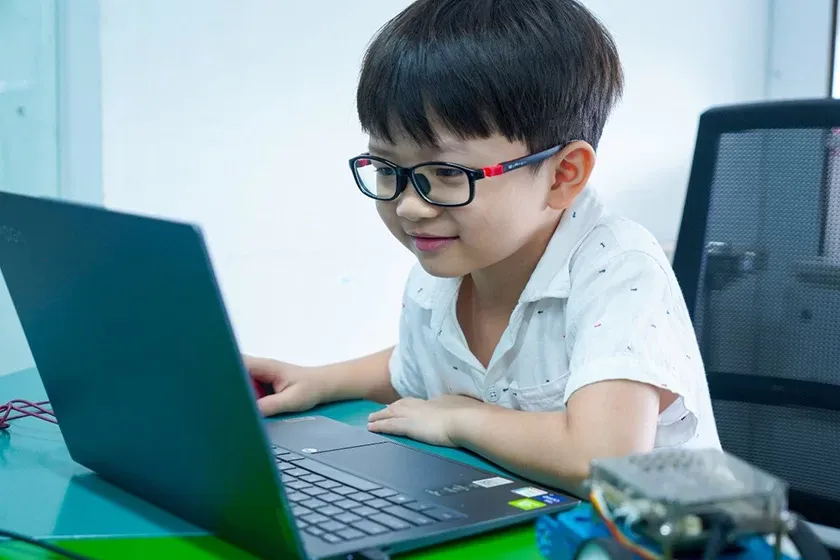

In an era of booming digital technology and artificial intelligence (AI), coding for children is no longer a luxury extracurricular activity. It is gradually becoming a foundational skill, much like learning a foreign language.
Faced with this trend, many parents feel anxious and rush to find coding classes in the hope of helping their children "get ahead of the future." However, forcing an elementary school child to confront complex lines of code and the dry syntax of professional programming languages too early can create psychological shock, turning natural curiosity into overwhelming academic pressure.
Learning to code is not about writing dry lines of code
The most common mistake parents make when they hear the term "learning to code" is imagining their children sitting in front of a computer for hours, typing endless black-and-white lines of code like software engineers. In reality, the core of programming education for young children lies in developing computational thinking. This is the ability to break down a large, complex problem into smaller, more manageable tasks; recognize recurring patterns; eliminate unnecessary details; and establish a logical sequence of steps to achieve a goal.

Once children develop this way of thinking, they gain a sharper analytical perspective when dealing with everyday situations, from planning their studies and cleaning their bedrooms to resolving personal conflicts. One of the most important skills they acquire is debugging, the ability to identify and fix errors. When a program fails to run, the computer itself is not at fault; the algorithm is simply incorrect. By bravely confronting mistakes and patiently checking each line of code to make corrections, children learn that failure is an inevitable part of the learning process. This helps them develop perseverance and the confidence to face life's challenges.
The starting stage (Ages 4-6)
During the preschool years, protecting children's eyesight and limiting their screen time should always be parents' top priorities. Therefore, the best way to introduce programming concepts at this age is through physical activities and real-world interactive games.
An algorithm, a concept that may sound complicated, is essentially a sequence of step-by-step instructions for completing a task. Parents can easily turn everyday life into an enjoyable programming game.
One classic activity is "Robot Walking." In this game, parents pretend to be a technologically clueless robot, while the child takes on the role of the programmer. The child must give precise and specific commands, such as "Take two steps forward," "Turn right 90 degrees," or "Bend down and pick up the ball," to guide the parent from the living room to the kitchen. If the child gives a vague command like "Go over there," the parent-robot simply stands still and reports an error. Through this activity, children learn the fundamental principle of computers: they operate only according to instructions that are extremely detailed, clear, and arranged in the correct order.
Additionally, playing logic board games with children, sorting toys by color and shape, or solving paper-based maze puzzles are excellent exercises for stimulating the prefrontal cortex and developing algorithmic thinking from an early age.
The breakthrough stage (Ages 7-9)
When children enter elementary school, their abstract thinking begins to develop rapidly, and their hand-eye coordination becomes more refined. This is an ideal time to introduce visual programming tools. Two of the most widely recognized platforms for this age group are Scratch and its simplified version, ScratchJr, developed by the Massachusetts Institute of Technology (MIT).
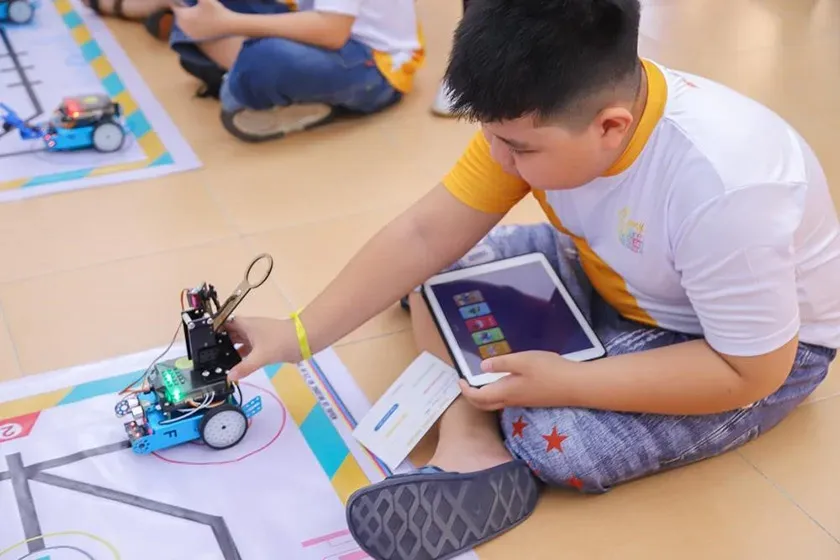
Instead of typing individual characters and risking mistakes, children use colorful blocks representing logical functions, loops, and conditions, dragging and dropping them together much like assembling Lego bricks. Modern educational programs often guide children from drag-and-drop programming toward basic robotics applications, allowing them to create tangible projects such as animated films and mini video games.
These tools provide immediate visual feedback. When children combine the "Move 10 Steps" and "Play Sound" blocks, the cat character on the screen moves and instantly says "Meow." The feeling of controlling a virtual world and creating their own stories allows children to develop a natural enthusiasm for technology without feeling as though they are struggling through a stressful academic subject.
The transition stage (Age 10 and above)
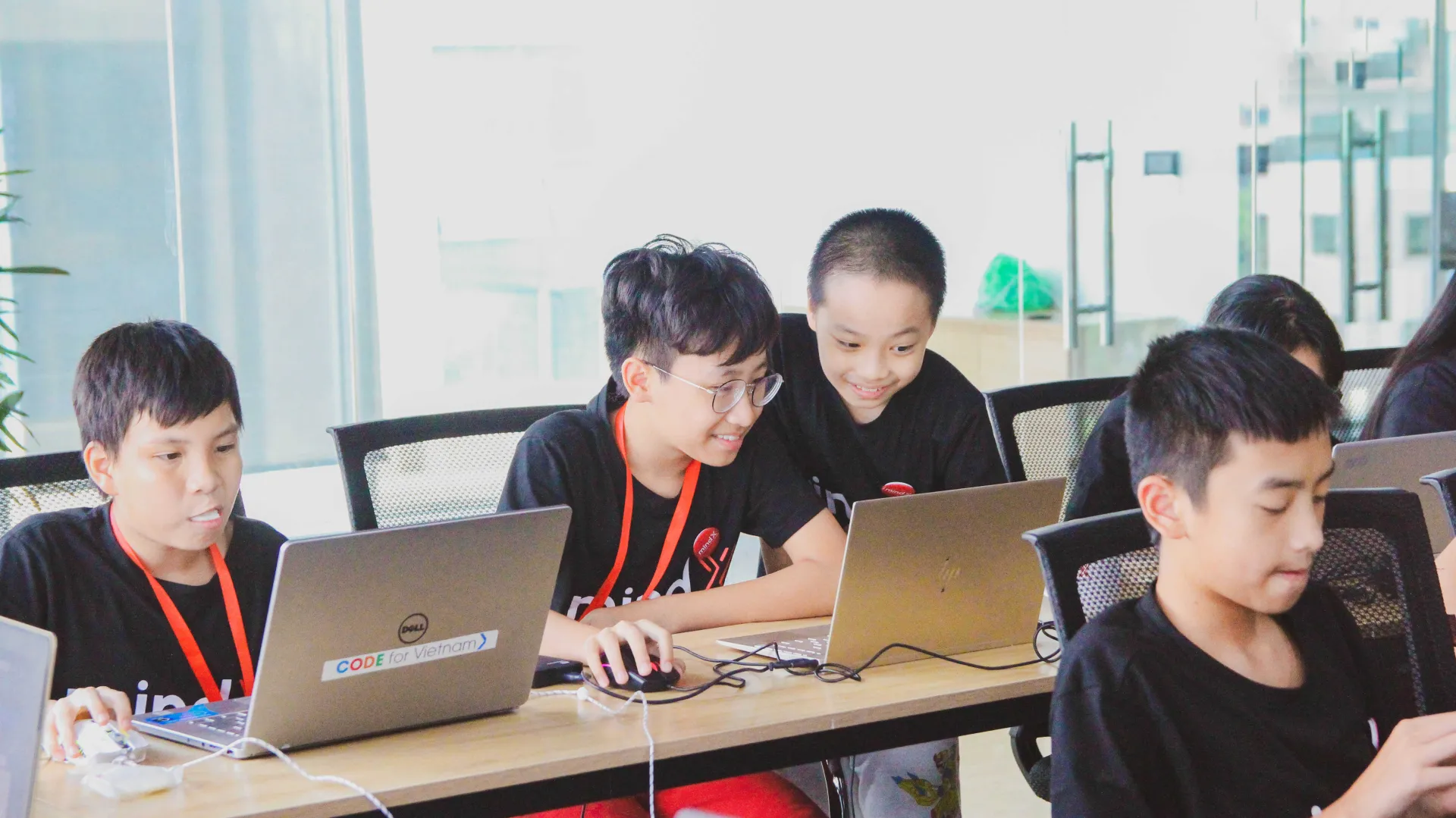
Once children have established a solid foundation in algorithmic thinking through block-based programming and begin to feel that colored blocks no longer provide enough freedom to express their ideas, parents can consider introducing text-based programming languages. Among these, Python is widely regarded as one of the best options for beginners and is recommended by technology education providers such as MindX.
Python's syntax closely resembles natural English and eliminates many cumbersome punctuation rules, significantly reducing frustrating syntax errors for young learners. In addition, combining Python programming with creative 3D game environments such as Roblox or open-source virtual world-building in Minecraft can be a powerful way to sustain children's interest. Rather than simply playing games for entertainment, children take on the role of game architects, controlling in-game physics and mechanics through their own Python code.
This provides an excellent stepping stone toward more advanced technologies, including mobile app development, website design, and even learning about the operating principles of artificial intelligence (AI) models in the future.
Success or failure in introducing children to programming depends far less on their innate talent or the price of their courses than on how their parents support them throughout the journey. The most important principle is to let children learn at their own pace and guide their progress through practical projects rather than grades or certificates.
Experts at leading educational organizations consistently emphasize encouraging children to create meaningful products that relate to their everyday lives. These could include an electronic birthday card for their mother, a quiz game to help classmates improve their math skills, or a simple application for tracking household chores.
When children see that their code can create real-world value, they naturally become more motivated to learn independently and explore further. Parents should act as curious companions, ready to sit down with their children to solve a challenging programming problem, encourage them when they discover a clever solution, and provide a steady source of emotional support as they prepare for the future.