
The rise of the digital economy and the rapid development of artificial intelligence (AI) are transforming the United States into a global hub for talent, with STEM fields playing a central role in reshaping education and career opportunities. No longer an unfamiliar concept, STEM has become a top destination for millions of international students, thanks in large part to strategic advantages provided by the U.S. government.
To build a solid academic pathway, students need to understand the core nature of STEM in the United States, as well as the practical reasons why these fields continue to hold a dominant position in the global labor market.
A comprehensive definition and scope of STEM fields in the United States
STEM is an acronym representing four foundational disciplines: Science, Technology, Engineering, and Mathematics. In the U.S. education system, STEM is not taught as a collection of isolated subjects. Instead, it is integrated through an interdisciplinary approach that emphasizes applying theoretical knowledge to solve real-world problems in everyday life and business.

The U.S. Department of Homeland Security (DHS) maintains a highly specific list of STEM-designated fields based on Classification of Instructional Programs (CIP) codes for the purpose of determining eligibility for certain immigration benefits. The scope of STEM is far broader than commonly perceived and encompasses four core pillars.
The Science category includes biology, physics, chemistry, environmental science, and neuroscience. Technology focuses on computer science, software development, cybersecurity, and emerging fields such as machine learning engineering and large language model (LLM) development. Engineering covers mechanical engineering, electrical engineering, aerospace engineering, and semiconductor technology. Mathematics includes pure mathematics, statistics, data science, and econometrics.
A distinctive feature of the U.S. system is that even analytically intensive fields within economics and business, such as Business Analytics and Quantitative Finance, can be officially recognized by DHS as STEM-designated programs when they meet the relevant criteria.
The three-year work opportunity through STEM OPT
One of the biggest reasons the United States has become a magnet for international STEM students is the Optional Practical Training (OPT) extension. Typically, international students who graduate from U.S. institutions are eligible to remain and work legally for up to 12 months under F-1 status. However, graduates whose degrees fall within an approved STEM-designated field may apply for an additional 24-month extension, bringing their total potential period of employment authorization to 36 months, or three years, without requiring an employer to immediately sponsor a work visa.
This three-year period provides a critical competitive advantage for international bachelor’s and master’s graduates. The additional time allows them to gain substantial professional experience at leading global corporations while potentially increasing their opportunities to participate in the H-1B visa selection process over multiple years.
Immigration surveys indicate that more than 73% of international graduates in science and engineering choose to remain in the United States five years after graduation, highlighting the significant role that immigration policies play in retaining highly skilled talent.
Higher earning potential and strong demand in the labor market
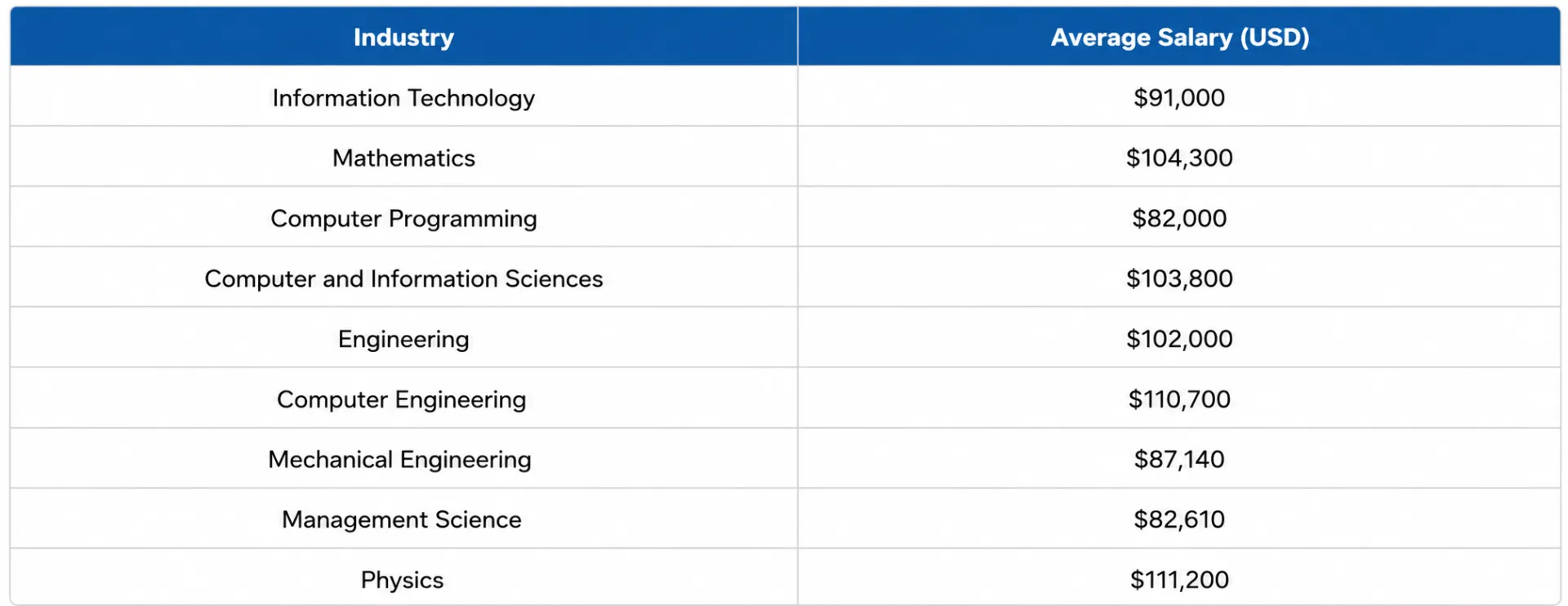
Investing in a STEM degree in the United States can offer a highly attractive return on investment (ROI), thanks to competitive starting salaries and strong income growth potential. According to official data from the U.S. Bureau of Labor Statistics (BLS), average annual wages for STEM occupations have exceeded $103,580. This figure is more than twice the median annual wage for all non-STEM occupations, which stands at around $48,000.
Demand for technical professionals remains exceptionally strong, particularly as traditional businesses are increasingly required to undergo digital transformation. The rapid expansion of fields such as cloud computing, renewable energy, biotechnology, and semiconductor technology is generating substantial demand for engineers and technical specialists.
Technology giants such as Google, Amazon, Microsoft, Meta, and Apple continue to conduct large-scale recruitment campaigns each year, offering highly competitive compensation packages and, in some cases, long-term immigration support to attract exceptional STEM talent.
World-class research environment and educational infrastructure
Choosing to study STEM in the United States means gaining access to one of the world's most advanced education systems, along with state-of-the-art facilities and research laboratories. Prestigious universities, from Ivy League institutions to leading technology institutes such as MIT and Caltech, receive billions of dollars each year from government agencies and private corporations to conduct groundbreaking research projects.
Students studying in the United States do not simply acquire knowledge from textbooks. They may also have opportunities to work directly in national laboratories, operate high-performance computing systems, or participate in applied clinical research. An academic environment that emphasizes critical thinking, creativity, and entrepreneurship helps students develop comprehensive problem-solving skills.
A STEM degree awarded by a reputable U.S. educational institution can serve as a powerful career credential, opening doors to professional opportunities not only in the United States but across the global job market.