Today, the aspiration to give children access to some of the world’s most prestigious education systems remains stronger than ever among Vietnamese families. According to the annual Open Doors 2025 report by the Institute of International Education (IIE), Vietnam continues to rank among the top five countries sending the largest number of international students to the United States, with more than 25,584 students. Notably, the Vietnamese international student community contributed nearly US$1.15 billion to the U.S. economy.
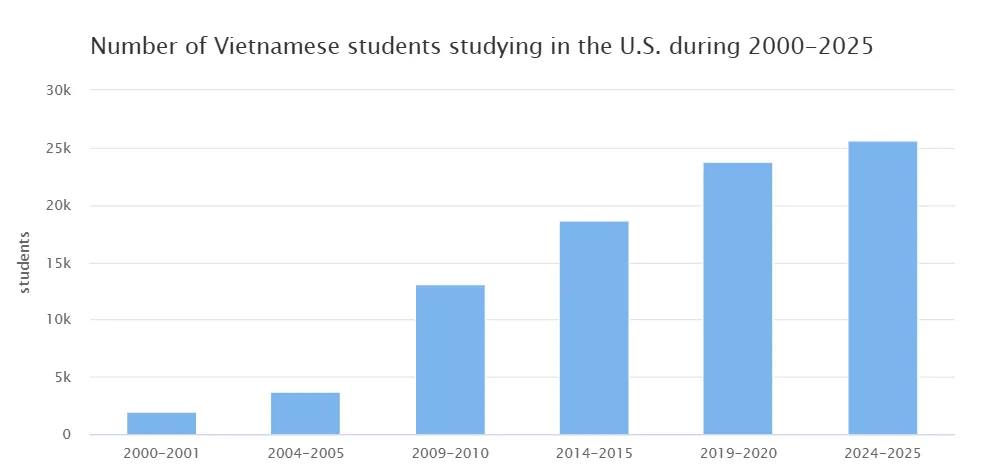
Behind those figures are thousands of families willing to stretch their finances to the limit, spending enormous sums, amounting to several billion, or even tens of billions, of Vietnamese dong, on four years of education for their children.
Data compiled by international education consulting organizations shows that annual tuition for studying in the United States averages between US$33,000 and US$48,000 at public universities, while prestigious private institutions can charge anywhere from US$48,000 to more than US$78,000 per year. When mandatory expenses such as living costs, health insurance, books, and transportation are added, averaging between US$18,000 and US$25,000 annually, the minimum total budget for a self-funded international student in the United States can easily reach US$50,000 to more than US$110,000 per year. Converted into Vietnamese currency, a four-year bachelor's degree in the United States can cost a family between VND 5 billion and more than VND 10 billion. For most middle-class Vietnamese families, this represents an enormous financial asset, often requiring them to sell accumulated real estate or drain their parents’ retirement savings.
Such a severe financial sacrifice naturally leads many families to expect a corresponding return on investment (ROI) after graduation. However, the reality of the U.S. labor market is cooling the hopes of many parents who expect their investment to be "recovered quickly." In-depth research from the Education Statistics Organization indicates that the financial return of a college degree depends heavily on the field of study. Majors such as computer science, engineering and other STEM disciplines, as well as quantitative economics, offer high starting salaries and favorable prospects for recouping the initial investment. By contrast, degrees in the humanities, arts and education tend to generate lower returns and may take decades to offset the initial cost. In Vietnam, this trend is reflected in IIE data, which shows that 23% of Vietnamese students choose business administration and nearly 22% choose computer science, largely to maximize their employment opportunities after graduation.

The biggest obstacle to achieving a return on investment for international students in the United States is the challenge of immigration and work authorization. The reality is that most international students cannot remain in the country permanently. According to analysis by the Economic Innovation Group (EIG), only around 37% to 41% of international graduates with bachelor's and graduate degrees remain in the United States over the long term. More concerning is the retention rate for those holding only a bachelor's degree, which is below 20%. In other words, roughly four out of every five international students who graduate with a bachelor's degree eventually have to leave the United States. The core issue lies in the stringent H-1B work visa system, in which selection is largely determined through a lottery. Even when highly capable students secure employment with major corporations during their OPT period, their chances of obtaining a long-term work visa and remaining in the country are still highly uncertain.
When the dream of settling or working in the United States does not materialize, many international graduates are forced to return to the Vietnamese labor market. This creates another paradox: a generational gap and a mismatch in income expectations. A graduate returning from the United States after an investment of VND 8 billion may find it difficult to accept a starting salary of VND 15 million to VND 25 million per month in major cities such as Hanoi or Ho Chi Minh City. In purely mathematical terms, at that income level, it could take decades for the graduate to earn back the amount their parents spent on their education, even before accounting for inflation or the opportunity cost of the money invested. The pressure to succeed and the enormous expectations placed on young people by their families can inadvertently turn a foreign degree into a psychological "burden," weighing heavily on their shoulders and making the process of building a career increasingly stressful and crisis-ridden.
Although the financial figures may appear discouraging, using money alone as the yardstick for measuring the value of education would be a narrow and superficial perspective. Many parents from affluent or ultra-high-net-worth families, as well as those with more progressive views, argue that spending billions of dong to send their children abroad is not primarily about recovering the investment or turning their children into profit-generating assets.
The intangible value offered by the U.S. education system lies in its ability to transform a young person's worldview, foster independent thinking, and develop the ability to live independently in a multicultural environment. Learning to manage everything from doing laundry and cooking to engaging in academic debate in American university classrooms can help students grow into confident global citizens. Meaningful relationships with international peers, elite alumni networks, and a liberal-arts-oriented mindset are invaluable assets that can serve as a springboard for building careers in virtually any country—something that monthly salary figures can never fully capture.