
Choosing between the United States, the world's leading educational powerhouse, and Australia, a country known for its strong social welfare policies and relatively clear pathways to permanent residency, is a difficult decision for thousands of Vietnamese families. Both countries offer prestigious degrees recognized worldwide, yet they operate under fundamentally different educational philosophies, cost structures, and immigration policies.

As countries continue to tighten visa controls and restructure their immigration systems, a thorough analysis of both quantitative factors (costs) and qualitative factors (opportunities) can help students and families make the safest and most strategic investment decision.
The nature of the education systems and academic structure
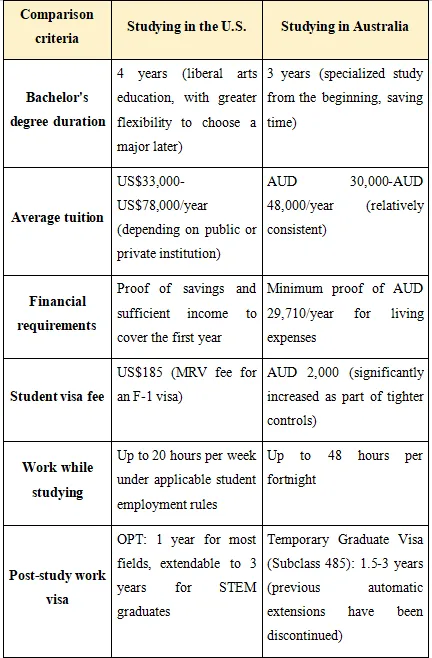
The fundamental difference between American and Australian higher education lies in the way undergraduate programs are designed. The U.S. education system follows the philosophy of liberal arts education, emphasizing well-rounded development and academic flexibility. International students pursuing a bachelor's degree in the United States typically spend four years completing their degree. During the first two years, students primarily take general education courses across a broad range of disciplines, from natural sciences to the humanities, before formally declaring a major around their third year. This provides a significant advantage for students who have not yet determined their career direction, allowing them to explore different fields and change majors with greater flexibility.
By contrast, Australia's education system is deeply influenced by the British model, placing greater emphasis on specialization and career-oriented learning from the outset. A bachelor's degree in Australia generally takes only three years, except for specialized fields such as engineering or medicine, which may require four years or more. Australian students begin taking major-specific courses from their first semester, with fewer general education requirements unrelated to their chosen field. This model allows students to optimize their time, graduate one year earlier than they would under the typical U.S. pathway, enter the workforce sooner, and save an additional year of living expenses.
Cost analysis: Tuition, living expenses, and financial requirements
The United States is a highly diverse education market in terms of cost. Tuition at U.S. public universities ranges from approximately US$33,000 to US$48,000 per year, while prestigious private universities and Ivy League institutions can charge more than US$78,000 annually. In return, the United States offers a substantial pool of scholarships and financial aid, with outstanding applicants potentially receiving assistance covering 50% to 100% of their educational expenses.
However, for students studying without scholarships, the total four-year cost in the United States can range from VND 6 billion to more than VND 10 billion. In terms of financial documentation, U.S. consular officers do not require applicants to submit a rigid, standardized financial-document package. Instead, applicants must demonstrate strong financial capacity and complete financial transparency during a highly scrutinized in-person visa interview.
In Australia, tuition fees are comparatively more consistent, averaging between AUD 35,000 and AUD 50,000 per year at universities belonging to the prestigious Group of Eight (Go8), with lower costs available at regional universities. Since mid-2024, the Australian government has continued tightening its regulatory framework to screen international students more selectively.
Notably, the minimum financial-capacity requirement has risen substantially to AUD 29,710 per year for a single student, excluding tuition and airfare. In addition, the application fee for Australia's Student Visa (Subclass 500) has increased from AUD 710 to AUD 2,000, a record-high figure intended in part to discourage people from using student visas as a means of entering the country primarily for unauthorized employment.
For a clearer comparison, the following table outlines the key differences between the two destinations:
Post-graduation employment and long-term immigration opportunities
If cost is the necessary condition, post-graduation opportunities are the sufficient condition for determining whether a multi-billion-dong education investment is truly worthwhile.
In the United States, the primary pathway for international graduates to remain and work is the Optional Practical Training (OPT) program. Graduates in non-STEM fields generally receive one year of OPT, while STEM graduates can qualify for an extension that brings the total period to up to three years.

However, OPT is only a temporary work authorization. To remain in the United States long term, an international graduate generally needs an employer to sponsor an H-1B petition. The greatest obstacle is that even an outstanding American degree does not guarantee a visa. The U.S. government uses a lottery-based selection system for H-1B visas when demand exceeds the available quota, making the process highly competitive and uncertain. As a result, the proportion of international students who successfully transition to long-term residency after completing a bachelor's degree in the United States remains below 20%.
In Australia, the pathway is comparatively more structured and predictable through the country's points-based immigration system. After graduation, eligible students can apply for the Temporary Graduate Visa (Subclass 485), allowing them to remain in Australia and work for approximately 1.5 to 3 years, depending on their qualification.
One notable aspect of Australia's latest policy reforms is the introduction of a maximum age threshold of under 35 for the Subclass 485 visa and the discontinuation of broad automatic extension policies. These reforms are designed to channel migration toward occupations facing significant shortages, including healthcare, nursing, early childhood education, and engineering.
For students who choose a strategically targeted field and are willing to relocate to designated regional areas where population and workforce growth are encouraged, the pathway toward permanent residency (PR) can be considerably more accessible than in the United States.