

When planning to pursue the American dream of studying abroad, tuition fees are often the first factor families consider. However, an equally important yet frequently overlooked variable is the cost of living across different states, which varies so significantly that it can completely reshape a student’s budget.
According to international education financial data, the total budget for one academic year in the United States can range widely from $35,000 to more than $85,000. This enormous difference is largely not driven by tuition fees at public universities, but by whether international students choose to live in expensive economic hubs or in states with more affordable living costs. Understanding the cost-of-living map across the country can help young people optimize their finances, reduce financial pressure, and build a more sustainable study plan.
The financial pressure of gateway states like New York and California
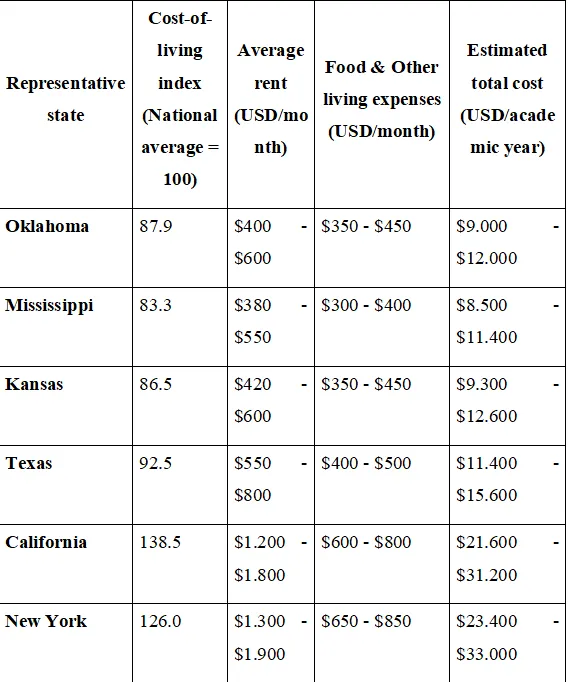
For many Vietnamese international students, coastal states such as California, New York, Massachusetts, and Washington are often among the first choices because they are home to bustling metropolitan areas and large Vietnamese communities. However, choosing these “promised lands” also means accepting extremely high living expenses, typically 30% to 50% above the U.S. national average.
According to an analysis by U.S. Immigration on the cost of living in the United States, an international student in California or New York may need to spend at least $2,000 to $2,500 per month on basic necessities. The heaviest burden comes from rent and urban services, with a small studio apartment or a shared room potentially consuming $1,200 to $1,500 per month. Such high living costs can create constant financial pressure, forcing many young people to divert attention from their studies to part-time jobs to make ends meet.
Affordable “havens” for international students in the South and Midwest
In contrast to the high costs of coastal metropolitan areas, the Southern and Midwestern regions of the United States offer a much more economical alternative, thanks to abundant land, moderate population density, and favorable tax policies. In states such as Oklahoma, Mississippi, Kansas, and Alabama, average living costs are consistently 15% to 20% below the national baseline.
Cost-of-living figures from Yocket, a platform for international students, show that in Mississippi and Oklahoma, rent for a two-bedroom apartment ranges from approximately $770 to $810 per month. For students sharing accommodation, this means spending only around $400 per month on rent. Food, groceries, and public services are also surprisingly affordable, allowing international students to maintain a comfortable lifestyle with total monthly expenses of only $800 to $1,200, roughly half the amount required in more expensive states.
In addition, these states are home to numerous large public universities offering highly competitive out-of-state tuition rates, creating an attractive return on investment (ROI) for international education.
Cost-saving strategies for international students regardless of location
Although choosing a state with a lower cost of living provides a major financial advantage from the outset, international students can still actively control and reduce their living expenses through smart lifestyle strategies. Prioritizing on-campus housing in lower-cost areas or proactively finding shared accommodation with two or three roommates when renting off campus is one of the fastest ways to split rent and utility bills.

In addition, developing the habit of cooking at home instead of relying on fast-food chains or food delivery services can not only support better health but also save $200 to $300 per month.
Finally, making full use of student discounts on public transportation, textbooks, and entertainment activities may seem like a collection of small savings, but they can add up significantly over time.