

In the journey of raising children, every parent hopes that their child will grow up to become a confident, disciplined individual who achieves success in life. To reach that goal, setting rules and developing discipline are essential. However, the line between “strict parenting” and “controlling parenting” is remarkably thin, causing many parents to cross it without even realizing it.
Many people mistakenly believe that requiring children to follow their parents’ every command is a sign of serious and responsible parenting. In reality, from the perspective of behavioral psychology and educational science, strictness and control represent two fundamentally different approaches. One serves as a foundation for building inner strength, while the other becomes a chain that suppresses a child’s natural development.
The nature of motivation
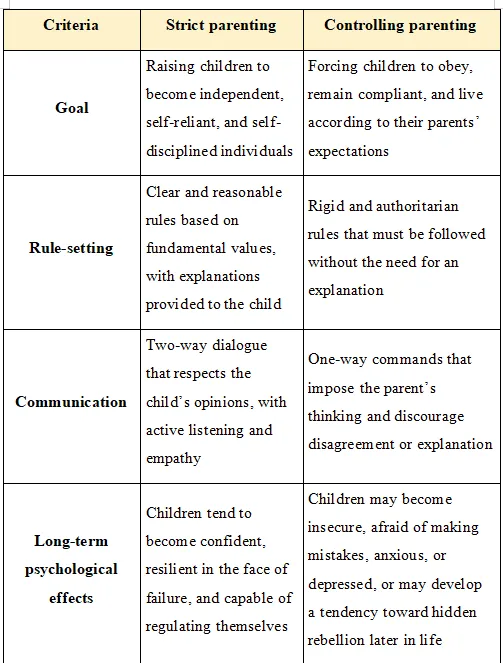
The first fundamental difference between strict parenting and controlling parenting lies in the nature of the motivation and the core goal that parents seek to achieve.
Strict parents base their approach on an ultimate goal: helping their children develop self-control, self-discipline, and a clear understanding of right and wrong. Healthy strictness is always accompanied by clear behavioral boundaries grounded in ethical principles and social safety. When a child does something wrong, strict parents explain the consequences and apply reasonable forms of discipline so that the child understands that every choice comes with responsibility. Ultimately, the purpose of strictness is to prepare children for the future and develop the strong will they need to stand on their own when they enter society.

By contrast, controlling parenting stems from a desire for total control and from parents projecting their own egos and unfulfilled expectations onto their children’s lives. Parents who adopt a controlling approach are less concerned with whether their children understand the reasoning behind a rule and more concerned with demanding absolute, mechanical obedience. Everything from a child’s interests and clothing to their choice of major and friendships must follow a predetermined script. In a controlling environment, the child’s individual will and emotions are suppressed to make room for the unquestioned authority of the parent. The essence of control is not education for the child’s independent future, but rather a subtle form of control carried out in the name of love to satisfy the parents’ own sense of security and pride.

Methods of interaction
The difference between these two parenting approaches is also clearly reflected in the way parents and children communicate on a daily basis.
Healthy strictness respects a child’s independent voice and their right to an explanation. Before establishing a rule or imposing a consequence, strict parents take the time to explain why the rule exists and why the child needs to follow it. They are willing to sit down with their children, listen to their thoughts and wishes, and discuss appropriate adjustments based on their age and level of maturity. Strictness can create a psychologically safe environment in which children understand the importance of rules while still feeling comfortable enough to open up when they face difficulties.
By contrast, communication in a controlling family often becomes a rigid, one-way system of commands with little room for negotiation. Authoritarian phrases such as “Because I said so” or “Everything we do is for your own good” are typical expressions of this mindset. Controlling parents may use threats, verbal aggression, physical punishment, or emotional withdrawal to force children to obey. They dismiss their children’s explanations and often view disagreement or independent opinions as signs of disrespect or ingratitude. The absence of empathetic dialogue can leave children feeling isolated within their own homes, turning the family relationship into a battlefield where everyone is constantly guarded and afraid of one another.
The impact on a child’s brain development and long-term personality
Different parenting approaches plant very different seeds for the kind of person a child becomes. Research in behavioral science and pediatrics has shown that appropriate strictness combined with warmth can nurture children’s emotional well-being, support brain development, and strengthen areas related to logical thinking and self-control. Children raised in structured and supportive families often develop greater resilience, a strong sense of self-worth, and the ability to take responsibility for their own actions. They understand that failure and mistakes are simply forms of feedback that can help them learn and improve. As a result, when they enter adulthood, they tend to be more confident, decisive, and capable of achieving success in their careers.
By contrast, the shadow of excessive control can seriously damage children’s mental well-being and hinder their intellectual development. When children are constantly exposed to pressure, threats, and unrealistic standards of perfection, their brains may remain in a defensive state, with prolonged stress associated with elevated cortisol levels. Excessive control deprives children of opportunities to reflect on their own behavior and take responsibility for their choices, potentially leading to two extreme patterns as they grow older.
Some may become passive and insecure, constantly afraid of failure and overly dependent on the opinions of others. Others may develop deep-seated resentment and learn to cope by pretending or hiding their true feelings around their parents, eventually expressing their frustration through intense rebellion or destructive behavior once they are free from their family’s control.