

Choosing a major when studying abroad is always a strategic problem that requires learners to balance personal interests, financial capacity, and especially the mobility trends of the global labor market. The differentiation in visa policies, economic development speeds, and occupational structures between developed countries and Vietnam requires learners to have a long-term vision right from before submitting their admission applications, because a trendy profession abroad may not necessarily have room to thrive when brought back home and vice versa.
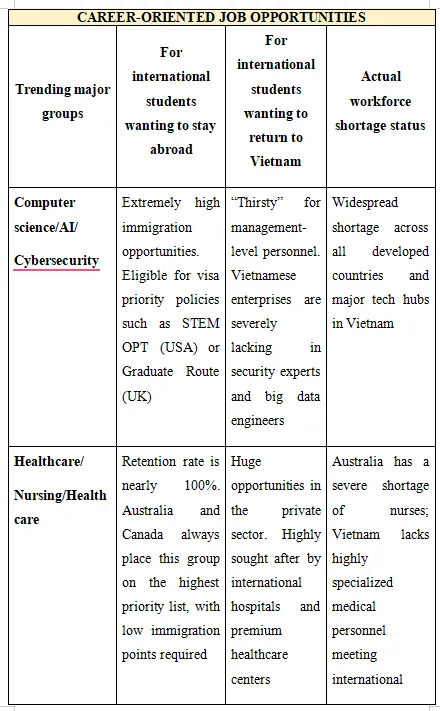
For international students whose ultimate goal is to remain in their host country after graduation, the top choices are the professions with workforce shortages announced annually by foreign governments. In Australia, reports from Jobs and Skills Australia indicate that the country is experiencing a severe human resources crisis in the health, technology, and engineering sectors. Graduates in nursing, software engineering, or civil engineering are always in the priority group for skilled visa processing thanks to a favorable immigration points system and fast processing times.
Similarly, Canada is also operating the Express Entry application selection mechanism based on occupations, in which the STEM and healthcare sectors always hold the dominant position. Possessing a degree in these fields not only helps international students easily find jobs but also serves as a guaranteed ticket for a long-term settlement pathway. In the US and the UK, although work visa policies are continuously being tightened and minimum salary requirements for sponsorship are being raised, computer technology, Artificial Intelligence (AI), and cybersecurity maintain their strong appeal thanks to privileges like the Optional Practical Training (STEM OPT) extension program of up to three years in the US.
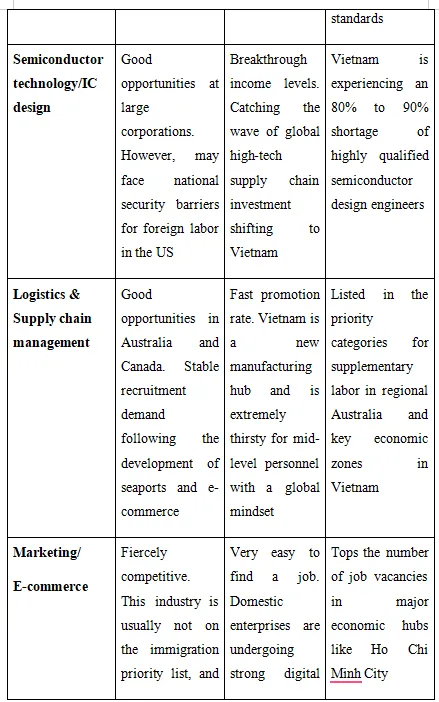
Conversely, for international students choosing to return to Vietnam after completing their studies, the domestic market opens up entirely different opportunities; the wave of digital transformation and global supply chain shifts are creating an unprecedented “thirst” for high-quality human resources. One of the biggest bright spots today is the semiconductor technology and IC design industry. Vietnam is becoming a strategic destination for major global technology corporations, but the domestic supply of human resources is severely lacking, with an estimated shortage of 80% to 90% of engineers with international standard professional qualifications. International students systematically trained in technological powerhouses will hold an absolute advantage and easily receive breakthrough remuneration packages upon returning home.
Besides, the cybersecurity and big data analysis sectors are also fertile grounds as Vietnamese enterprises enter a fiercely competitive phase using technology. Recruitment demand is no longer aimed at general programmers, but focuses on hunting down experts with a systems management mindset, data security capabilities, and the ability to interpret consumer behavior through actual data.
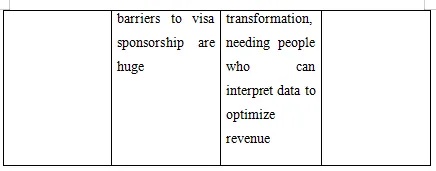
The clearest difference between these two orientations lies in the economics and services sectors. While an international student studying traditional marketing or general business administration will face fierce competition and huge visa barriers in Australia or the US because these are not priority shortage sectors, upon returning to Vietnam, they become highly sought after by multinational corporations and large domestic enterprises. The Vietnamese market, with its young population size and outstanding e-commerce growth rate, always demands a large number of mid- and high-level personnel capable of international communication, quick adaptation thinking, and a deep understanding of modern marketing tools. Surveys on recruitment demand in major economic hubs like Ho Chi Minh City always record business, sales, and marketing sectors at the top in terms of job vacancies. Therefore, clearly determining the coordinates of your future career, whether to stay or return, will decide if you should invest in highly specialized global engineering fields or flexible management fields with high applicability in the local market.
There is no single perfect major for every goal, only the most suitable major for an individual's settlement or startup strategy. If wanting to settle in developed countries, international students must take the path of investing heavily in healthcare, nursing, or highly specialized engineering and technology according to the host government's priority lists. Conversely, if determined to return to contribute and advance in Vietnam, majors that anticipate the wave of FDI investment such as semiconductor technology or digital transition sectors like marketing data analysis and supply chain management will be the most solid launchpad to turn a study abroad degree into an outstanding competitive advantage in the labor market.