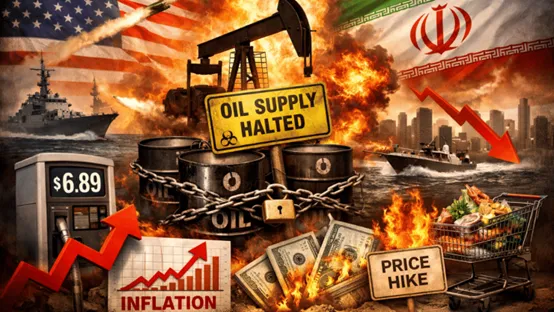

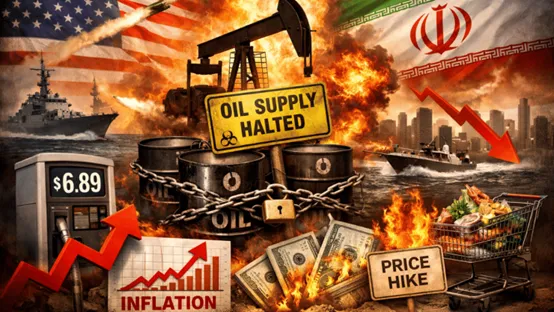
Human history has witnessed countless conflicts, but the current geopolitical context is exposing an unprecedented reality: war has transcended the narrow confines of pure military engagements. The gunfire on the battlefield is now just the tip of a giant iceberg. The world is entering the era of "multi-layered war," a haunting concept where bombs and bullets, energy flows, and financial indices intertwine and resonate to create unprecedented destruction to the entire global system.
To clearly understand the ferocity of this war, we must peel back each of its layers, where every front acts as a weapon of destruction.
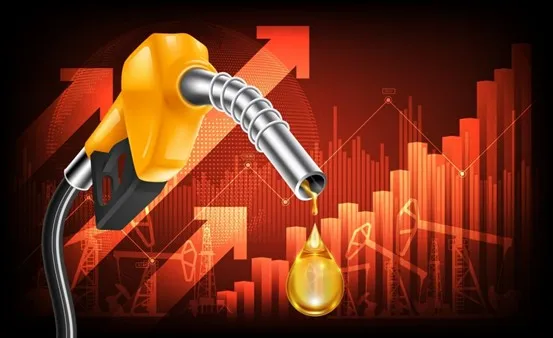
On the first layer, the military front emerges with the ruthlessness of high tech: lightning-fast airstrikes, swarms of suicide drones plunging straight into the dark heart of infrastructure systems and critical petrochemical refinery facilities. As soon as the explosion resounds, the second layer of war is immediately activated: the energy front. Warring parties make the most of their geographical positions to blockade vital transport routes, ruthlessly squeezing logistics bottlenecks and deliberately sabotaging supply in order to "weaponize" scarcity. And then, the shockwaves from the two fronts above immediately spread to the third layer, equally devastating and unpredictable: the financial front. According to records from Reuters, the trading volume of oil futures contracts has hit record thresholds, accompanied by a wave of frantic speculation in the energy market, turning trading floors into machines that amplify panic and rake in profits from the instability of the conflict.
The inevitable consequence of this intertwined war structure is a devastating earthquake simultaneously striking the core pillars of the global economy. A missile falling onto an extraction zone not only destroys an oil tank, but in a split second, it ignites wild fluctuations in the price of "black gold," triggers panicked sell-offs in the stock market, and rocks the exchange rates of a series of national currencies. Oil, stocks, and currencies no longer fluctuate independently according to normal economic cycles, but are tied together in a crisis spiral driven by war.
The sharpest difference, defining the nature of conflicts in 2026, is the complete evaporation of traditional boundaries. If previously, observers could clearly distinguish what constituted an economic sanction, what was a military attack campaign, or what was a financial manipulation trick, now they have all merged into one. A financial embargo decision has a lethal power equivalent to a tank division, and a strait blockade order can vaporize trillions of USD on electronic boards in the blink of an eye. Economics, military, and finance have united into a single war machine, ruthless and devoid of any safe buffer zones.
From that brutal reality, policymakers are forced to acknowledge a thorny truth: modern war is no longer a localized contest of strength between two or more individual nations, but has become a systemic war of a global nature. Any rupture in a local link immediately spreads, testing the resilience of the entire international trade and logistics network. No nation, no matter how far from the war zone, can confidently declare itself completely immune to these chain-reaction shocks.
Finally, the shaping of multi-layered war is completely rewriting the definition of the winner on the geopolitical chessboard. Supreme power is now no longer framed in reports about the scale of firepower or the number of legions. The laurel wreath of the 21st century will not go to the one who only knows how to use muscle power to flatten the enemy, but belongs to the power capable of dominating, manipulating, and holding the hinges of both the global energy system and the financial network.
In this era, the strongest is the one who controls the economic heartbeat of the world.