
The dream of setting foot in the United States and obtaining the coveted Green Card (permanent resident status) has never lost its appeal among generations of Vietnamese people. Long portrayed as the promised land with world-class education, a dynamic free-market economy, and advanced healthcare benefits, the United States remains a top migration destination for many families. However, as the U.S. Department of Homeland Security continues to tighten immigration regulations and narrow pathways to legal immigration, moving to the United States is no longer a matter of luck or emotionally charged promises made by immigration brokers.
The safest and most appropriate path for Vietnamese applicants does not begin with submitting an application or buying a plane ticket. It begins with assessing one’s assets and personal qualifications to identify the most suitable immigration category, while simultaneously building a transparent financial history and developing the practical skills needed to adapt before walking into a U.S. consular interview.
Researching and choosing the right Visa category
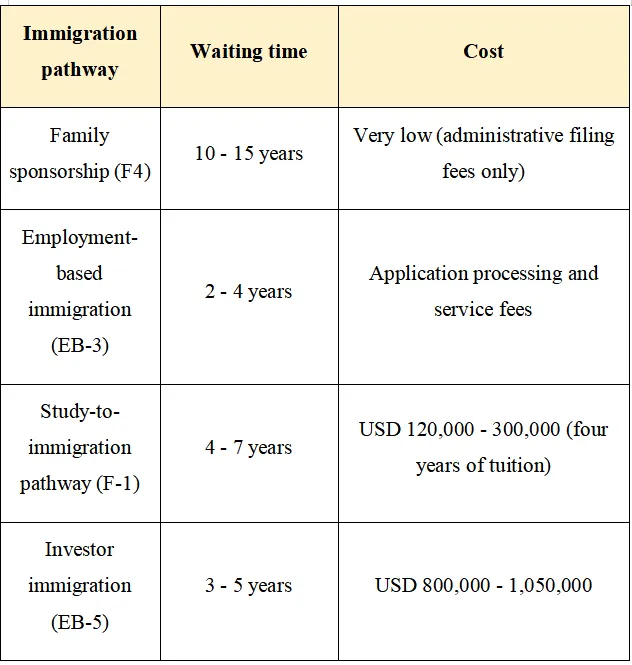
U.S. immigration law is highly stringent, but it is also clearly divided into specific categories of applicants. The first is family-sponsored immigration, one of the most common pathways but also one that can involve extremely long waiting periods for Vietnamese applicants. If you have a spouse or parent who is a U.S. citizen, processing may be relatively faster. However, those applying through the sibling category (F4) may face extraordinarily long wait times. Visa Bulletin data shows that applicants can face waits of 10 to 15 years. Therefore, if a family does not have a strong qualifying relationship, placing all hopes in family sponsorship can sometimes turn into a time trap, consuming an applicant’s prime years of education and career development.
The second category is employment-based immigration, an ideal pathway for qualified professionals as well as certain skilled and unskilled workers sponsored by U.S. employers. Young Vietnamese applicants today often consider the EB-3 category, which covers professionals, skilled workers, and other workers, or EB-2 NIW (National Interest Waiver), designed for individuals with advanced degrees or exceptional ability whose work can be shown to serve the national interest.
Another increasingly common indirect pathway is to study in the United States on an F-1 student visa, use the Optional Practical Training (OPT) period to gain professional experience, and then seek employer sponsorship for an H-1B work visa through the lottery system before eventually pursuing permanent residence. This route requires young applicants to have strong academic credentials, fluent English proficiency, and the psychological resilience to navigate the highly competitive U.S. labor market.
For families with substantial financial resources, EB-5 investor immigration offers a more direct pathway. Under the current framework of the EB-5 Reform and Integrity Act, the minimum required investment is $800,000 for qualifying projects located in a Targeted Employment Area (TEA), such as certain rural areas or locations with high unemployment, and $1.05 million for standard investment areas. A fundamental requirement is that the investment must create at least 10 full-time jobs for qualifying U.S. workers. Although this pathway can potentially shorten the overall immigration process to several years, it presents a major legal challenge for applicants in Vietnam: proving the lawful source of their investment funds.
Preparing legal and financial documentation at home
Proving that funds have a legitimate and traceable source is one of the biggest hurdles facing wealthy Vietnamese applicants pursuing EB-5 or other immigration categories requiring financial documentation. The U.S. Citizenship and Immigration Services (USCIS) closely examines the history of how an applicant accumulated their assets.
Investment funds must be supported by evidence showing that they came from legitimate sources, such as documented employment income, lawful business profits, properly documented real-estate transactions, or legal inheritance. Equally important, applicants may need to provide evidence that all applicable tax obligations in Vietnam have been properly fulfilled.
Funds accumulated through undocumented cash transactions, opaque financial channels, or real-estate transactions in which property values were deliberately understated to evade taxes can create serious problems during the source-of-funds review and may ultimately lead to the denial of an application after years of waiting.
Survival skills and psychological resilience
Many Vietnamese applicants make the mistake of assuming that having money and a Green Card will automatically guarantee a comfortable life in the United States. In reality, life in America operates according to a very different system, involving significant tax obligations, potentially high health-insurance costs, and the need to establish a strong credit history in order to rent a home, finance a car, or access other essential services.

Therefore, even before leaving Vietnam, improving professional English communication skills, preparing documentation for the recognition or evaluation of professional qualifications, and establishing an emergency financial reserve sufficient to cover at least six months of living expenses in the United States are essential steps.