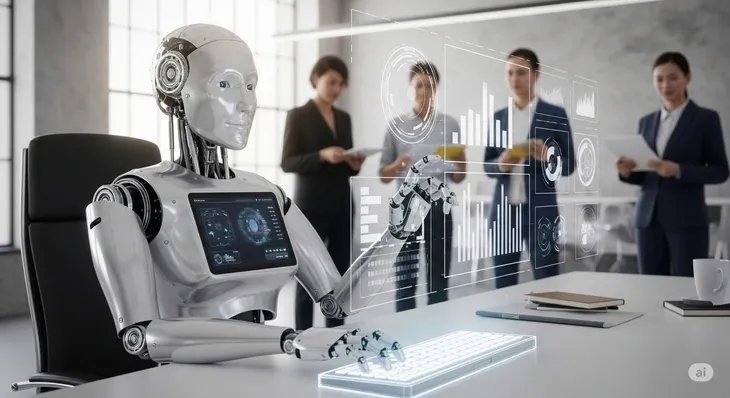

The boom of Artificial Intelligence (AI) is no longer a distant forecast but has become a wave comprehensively reshaping the global labor market. From coding, accounting data processing, and translation to practical graphic design, AI is demonstrating speed and efficiency that far surpass humans.
The pressure from technology today is clearly evident, as the World Economic Forum's (WEF) Future of Jobs Report predicts that approximately 92 million jobs will be displaced between now and 2030 due to the impact of AI and automation trends. Research from the investment bank Goldman Sachs also indicates that two-thirds of current jobs in the US and Europe are exposed to some degree of AI automation. In Southeast Asia, the rapid pace of digital transformation is putting personnel in repetitive or clerical roles at a high risk of elimination.
However, market research by the Boston Consulting Group (BCG) asserts that the complete replacement of a job by AI will occur very slowly; instead, technology plays a role in reshaping and collaborating. The essence of "defending" against the AI wave lies in the unique, non-codifiable human values found in occupational groups considered the most solid "fortresses" against the encroachment of algorithms.
Medicine, healthcare, and intensive therapy

The first sector to stand firm against this wave is medicine, healthcare, and intensive therapy. Although AI systems are capable of analyzing millions of medical records to provide treatment regimens or reading X-rays with high accuracy, clinical medicine will always require human hands and minds.
The factors that make this sector impregnable are empathy, emotional intelligence (EQ), along with legal and ethical responsibility. A survey by the US Career Institute (USCI) ranks physician assistant positions among the group with a strong workforce growth rate of up to 27.6% because this job requires acumen and the ability to handle split-second emergencies based on immediate intuition. Similarly, the US Bureau of Labor Statistics (BLS) forecasts that the direct healthcare sector will grow by 8.4% over the next decade, with the demand for advanced practice nurses skyrocketing by 45.7%. Patients do not merely need dry technical parameters; they need comforting, listening, and physical care in a complex physical environment, something no robot today can economically simulate.
For psychologists and social workers, human mental health is inherently a maze of emotions, trauma, and social contexts. Thus, an AI chatbot, even if it has memorized every psychology textbook, cannot forge the bond of trust or profound empathy that exists between humans.
Education and management

Alongside healthcare, orientational education, management, and human connection are also hard-to-replace fields thanks to the role of character building and cultural shaping in traditional classrooms. AI can flawlessly convey theoretical knowledge, but the role of the teacher in the AI era has shifted from a mere transmitter of knowledge to a cognitive guide. Teachers are the ones who stimulate critical thinking, hone soft skills, and mold student behavior, as machines will never know how to encourage a self-deprecating child or discover the innate talents hidden within a rebellious student.
In the field of management, CV screening or timekeeping can be delegated to AI, but PwC's Global AI Jobs Barometer indicates that the recruitment demand for professionalized positions where humans are responsible for managerial decision-making, strategic hiring, and conflict resolution is growing twice as fast as purely executional jobs. Understanding human nature, retaining talent, and shaping corporate culture always require an incredibly complex EQ filter that algorithms cannot compute on their own.
Artistic creation

Original artistic creation and macro-planning represent another solid human fortress. Generative AI creates images, sounds, or text by learning from and combining existing past data, but it entirely lacks subjective consciousness, real-life experience, and the ability to break free from old paradigms. Art touches the heart because it contains cultural experiences, pain, happiness, and even the intentional imperfections of the creator.
According to USCI data, the choreography and physical arts creation industry is expected to grow by up to 29.7% due to its unique originality, proving that AI can only mimic styles rather than create an entirely new artistic movement. For senior business strategists, when the market falls into states of uncertainty or unprecedented crisis, AI's past data models become useless. Contrarian, visionary decisions by macro-managers based on political and social intuition are something algorithms are completely powerless to replicate.
Engineering/Architecture

Finally, skilled technical trades and jobs in dynamic environments also demonstrate a reality contrary to the previous misconception that manual labor would be the first to be replaced. Programming an AI software to run in digital space is much easier and cheaper than manufacturing a robot capable of moving deftly in a highly volatile, real-world three-dimensional space.
A Microsoft Research report points out that jobs requiring manual dexterity combined with on-the-spot problem-solving, such as electricians, plumbers, and mechanics, are the safest from AI. Every house, pipe, and engine has a different state of disrepair; diagnosing faults in tight, complex spaces requires mechanical flexibility and continuous improvisational problem-solving. Even within the tech industry itself, regular programmers face fierce competition from AI, but the demand for senior software engineers is soaring because humans remain the ultimate link in designing overall system architecture, testing safety levels, and bearing the highest responsibility for security.