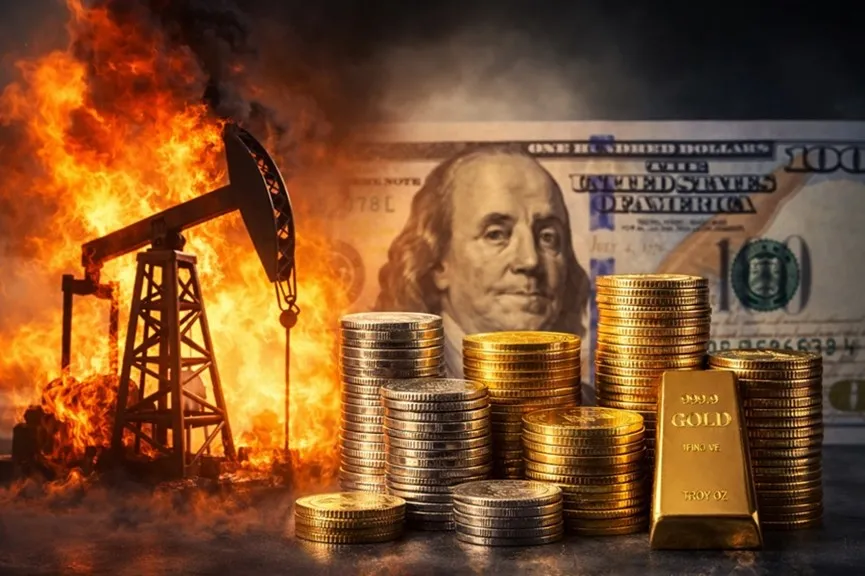

In classical economics, the price of any commodity is determined by the basic supply-demand balance. However, the global black gold market is a highly complex exception, where dry mathematical principles frequently have to give way to an invisible yet powerful factor: investor psychology. When the dark clouds of geopolitical conflict gather in the Middle Eastern sky, the price of oil not only reflects the number of barrels being pumped from the ground but is also the truest measure of human fear regarding an uncertain future.
The psychological effect in warfare impacts the oil market like a chain reaction, starting from rumors and ending with dancing numbers on electronic boards. As soon as the first gunshot rings out or diplomatic threats are launched, the obsession with vital waterways being blockaded immediately arises. Narrow straits like Hormuz or Bab el-Mandeb are not just maritime routes for ships, but the "chokepoints" of the global economy. When the fear of an energy crisis spreads, factories worry about lacking production fuel, nations worry about stagflation, and that is precisely when financial speculators jump in. They do not buy oil to use, but buy options and futures contracts based on the expectation that prices will rise further. It is this excessive expectation and herd mentality that creates a massive virtual demand, pushing oil prices soaring long before any actual drop of oil is withdrawn from the market.
This psychological amplification could not happen without the central role of giant commodity exchanges like the New York Mercantile Exchange (NYMEX) in the US or the Intercontinental Exchange (ICE) in London. These are sophisticated financial machines, where millions of "paper oil barrels" (derivative contracts) change hands every day, far exceeding the volume of actual physical oil that exists. At NYMEX or ICE, the slightest fluctuation from the Middle Eastern battlefield is priced by algorithms and traders into risks and calculated into money in mere milliseconds. When pessimistic sentiment prevails, these exchanges turn into "panic amplifiers." A sensitive piece of news can trigger a barrage of automatic stop-loss buy orders, pushing WTI or Brent crude oil prices to break technical resistance levels, despite the fact that strategic reserves around the world are still full.
Modern history has repeatedly witnessed "oil price shocks" molded from this very panic psychology, especially in the vortexes of conflict in the Middle East. The prolonged and complex conflict between Israel and Palestine, or recently the involvement of Houthi forces in the Red Sea, is always a looming detonator. Although Israel and Palestine themselves are not major oil producers, their geographical location at the navel of the world's largest energy-exporting region makes the market always bet on the risk of the war spreading throughout the entire area. Similarly, periods of extreme tension between Iran and the US, from the withdrawal from the nuclear agreement and strict economic sanctions to drone attacks on oil refinery facilities, are always accompanied by Tehran's threats to close the Strait of Hormuz. Each time, world oil prices experience violent convulsions, creating new price peaks that leave even financial analysts astounded.
These fluctuations expose an ironic truth of the modern energy market: in many cases, oil prices skyrocket because people fear that war will cause an oil shortage, not because the market is actually facing a deficit. Fear has inherently become an invisible tax inflicted upon every consumer on the planet, from the price of a liter of gasoline at the pump to the cost of an airplane ticket.
As long as the Middle East remains a cauldron of geopolitical conflicts, "market psychology" will continue to be an unpredictable variable, ready to bend all forecasts and manipulate the value of the black gold flowing through the veins of the world economy.