

Writing a CV: The Stepping Stone to Reaching Your Dream Job
In an increasingly competitive labor market, a good degree or excellent academic achievements are sometimes still not enough to help candidates secure their desired jobs. Before employers have the chance to meet you in person, they will evaluate you through a single document: your CV. With just a few dozen seconds of scanning, recruiters can decide whether you deserve to advance to the interview round. Therefore, investing in a professional-looking CV is not only an essential skill but also the first "passport" on your career path.
What is a CV?
CV (Curriculum Vitae) is a brief summary of important information about yourself, such as education, work experience, skills, achievements, certifications, and outstanding activities. This is a tool that helps recruiters quickly assess whether you are a good fit for the vacant position.
Unlike a cover letter, a CV does not focus on expressing personal desires but emphasizes the competencies, experience, and value that the candidate can bring to the business.
Why Do You Need a CV When Applying for a Job?
A CV is considered a candidate's first impression on the recruiter. A CV presented in a scientific, complete, and professional manner will help you stand out among hundreds of other profiles.
In addition, a CV also helps to:
Briefly yet fully introduce yourself.
Demonstrate personal experience, competence, and strengths.
Prove seriousness and meticulousness when applying.
Increase the chances of being invited to an interview.
Help recruiters easily evaluate suitability for the job position.
For fresh graduates or those without much experience, a well-structured CV can still create an advantage if you know how to highlight skills, academic achievements, and extracurricular activities.
Essential Components of a CV
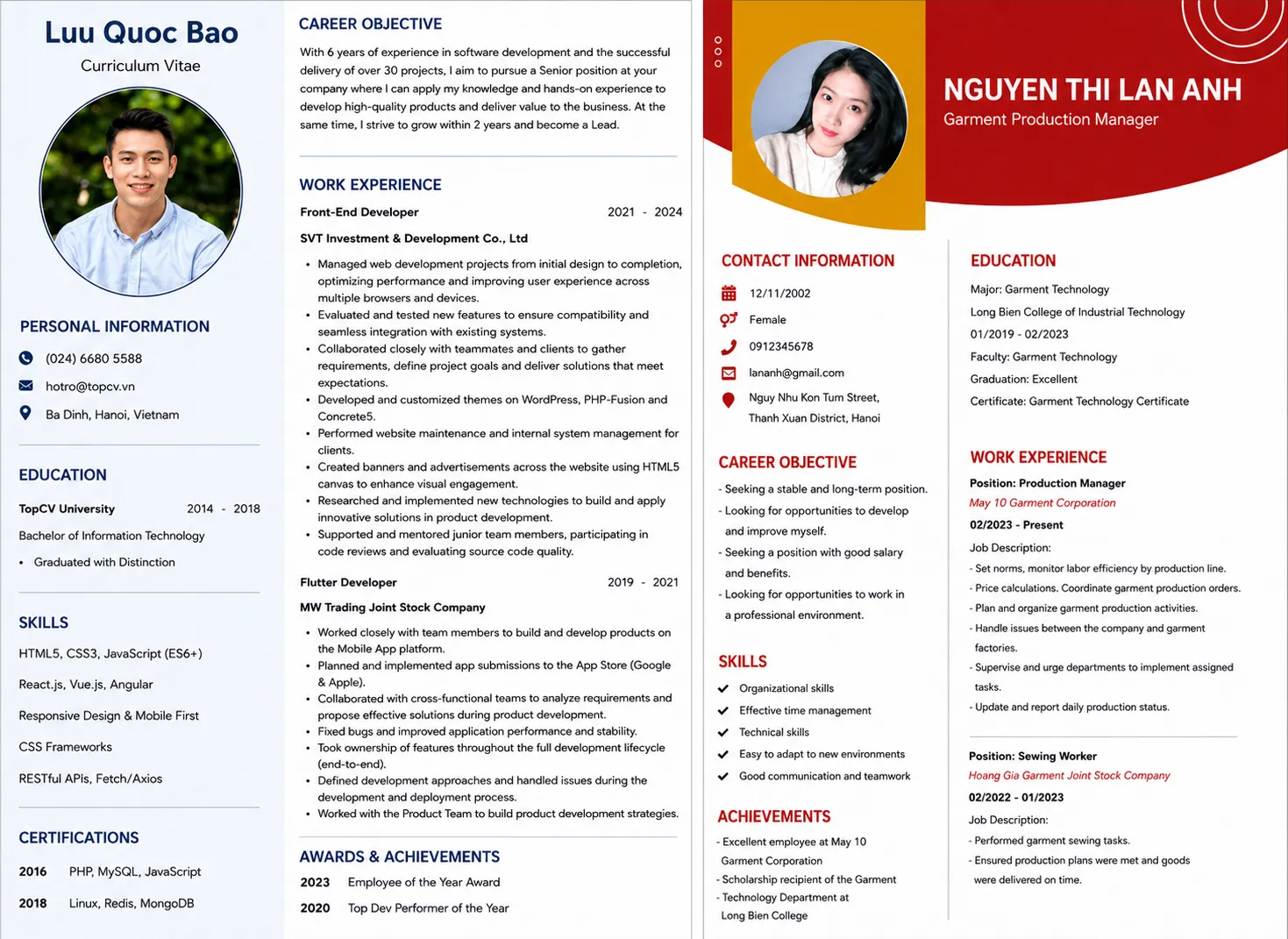
A professional CV does not need to be too long, but it must contain all vital information. Typically, a CV should include:
1. Personal Information
Full name, phone number, email, address (no need for too much detail), LinkedIn link, or Portfolio (if applicable).
2. Career Objective
Briefly present your career direction and the value you wish to contribute to the company. This section should only be 3 to 5 lines long.
3. Education
List schools, majors, duration of study, GPA (if outstanding), and relevant awards or achievements.
4. Work Experience
Arrange in reverse chronological order (from newest to oldest). For each position, clearly state:
Company name
Job title
Employment period
Main responsibilities
Achievements (prioritize using specific data)
Example: "Increased sales revenue by 25% after 6 months" will be much more persuasive than just writing "Sales".
5. Skills
Only list skills relevant to the position applied for, such as:
Office computing
Communication
Teamwork
Problem-solving
Foreign languages
Time management
Design, programming, or other specialized skills
6. Certifications
Include language certificates, IT certificates, or relevant professional certifications.
7. Extracurricular Activities and Projects
This is a very important section for students or those without much experience. Volunteer activities, clubs, or personal projects all help demonstrate a sense of responsibility and working capacity.
8. Outstanding Achievements
If you have received scholarships, awards, titles, or have typical products, include them in your CV to increase competitiveness.
How to Make an Impression on Recruiters
A beautiful CV lies not only in its format but also in how information is conveyed. To make an impression right from the first glance, you should note:
Design a clear, readable, and consistent layout.
Limit your CV to 1 A4 page (or a maximum of 2 pages if you have a lot of experience).
Use professional fonts and reasonable sizes.
Place the most important information at the top.
Tailor your CV content to each specific position instead of using one template for all jobs.
Use strong action verbs like "manage", "build", "develop", "optimize", "achieve", "implement" to describe experience.
Prioritize giving specific data to prove achievements.
Double-check for spelling, grammar, and formatting errors before sending.
Use a professional email address instead of personal or unprofessional ones.
If possible, add links to your Portfolio or practical projects to increase credibility.
The Importance of a CV
A CV is not merely a personal introduction but also a tool that reflects the mindset, professionalism, and presentation skills of each candidate. A carefully invested CV can help you pass the initial screening round, create an advantage over competitors, and open up better career opportunities.
In the context of many businesses using Applicant Tracking Systems (ATS), building a standard CV and using keywords that match the job description also contributes to improving the chances of your resume being selected.
Remember, recruiters are not just looking for talented people, but they are looking for people who know how to express their value. And your CV is where you prove that.