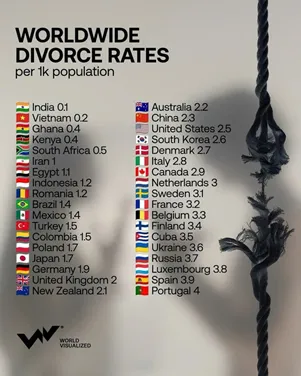

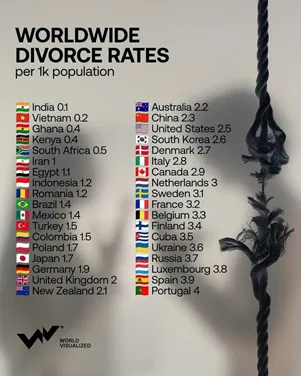
According to some statistics on global divorce rates (calculated per 1,000 people), the level of divorce varies significantly across countries. For example, India has a very low rate of about 0.1, Vietnam is around 0.2, and Ghana and Kenya are about 0.4. Meanwhile, many developed countries have higher rates, such as the United States at about 2.5, South Korea at 2.6, France at 3.2, Russia at 3.7, and Portugal reaching up to about 4. These figures show that divorce is a social phenomenon occurring in many parts of the world, although the extent varies depending on the culture, economy, and concept of marriage in each country. This also reflects that not every marriage can be maintained long-term if problems in married life are not resolved in a timely manner.
Marriage is a major turning point in each person's life. The path to marriage is not always the same. Some people marry for love after a long period of getting to know each other and forming an attachment. Some come to marriage through matchmaking by family or relatives. In some other cases, marriage can stem from social pressure, arrangement, or even coercion. Regardless of the starting point, the common goal of marriage is to build a happy and sustainable family. However, not every marriage can maintain long-term stability. When problems accumulate over time, the marital relationship can gradually fracture and face the risk of breaking down.
One of the clearest signs of a marriage in crisis is a lack of communication between spouses. Previously, they might have shared everything in life, but gradually conversations become less frequent, eventually reducing to only the necessary words for daily routines. Prolonged silence causes the emotional gap to widen. Besides this, more frequent arguments and the difficulty in finding common ground are also worrying signs. When two people no longer want to listen to or understand each other, even a small conflict can turn into a major problem.
A shift in how they care for and nurture each other also indicates that the relationship is in trouble. When one or both individuals become indifferent, share fewer emotions, and no longer dedicate time to the family, it can signify a decline in affection. In some cases, a person may tend to seek attention outside, spending more time on work, friends, or other relationships instead of their family.
These signs often stem from a variety of causes. A common cause is the difference in life perspectives, goals, and ways of thinking between husband and wife. When entering a marriage, each person brings their own habits, values, and expectations. If they do not know how to compromise and respect one another, these differences can lead to prolonged conflicts. Additionally, economic pressure is a crucial factor. Financial difficulties, spending burdens, or disagreements over money management can easily leave a couple stressed and exhausted.
Another cause is a lack of attention and sharing in daily life. When work, responsibilities, and other worries consume too much time, the two can gradually drift apart without realizing it. In particular, marriages that began from coercion or lacked a strong emotional foundation from the start also face greater difficulties in maintaining long-term attachment.
A lack of respect and trust is another element that weakens the foundation of a marriage. When trust is damaged or there is no longer a sense of safety within the relationship, healing becomes much harder. If problems are not addressed promptly, they can accumulate and lead to a breakdown.

A marriage on the verge of breaking down usually has many different signs and causes, ranging from a lack of communication and prolonged conflicts to life pressures and personal differences. Recognizing these signs early can help couples reflect on their relationship and find ways to improve before it is too late. For a marriage to be sustainable, it requires understanding, respect, and effort from both sides.