
Peer Pressure at the age of 22 - 25: When others are running, and you are still struggling to find your way
There is a very familiar saying: “Not everyone is moving faster than you, it's just social media making you think so.” However, for many young people aged 22 - 25, the feeling of being left behind is so real that it makes them lose sleep, doubt themselves, and constantly ask: “Why are others successful, but I am not?”. That is exactly when peer pressure silently appears.
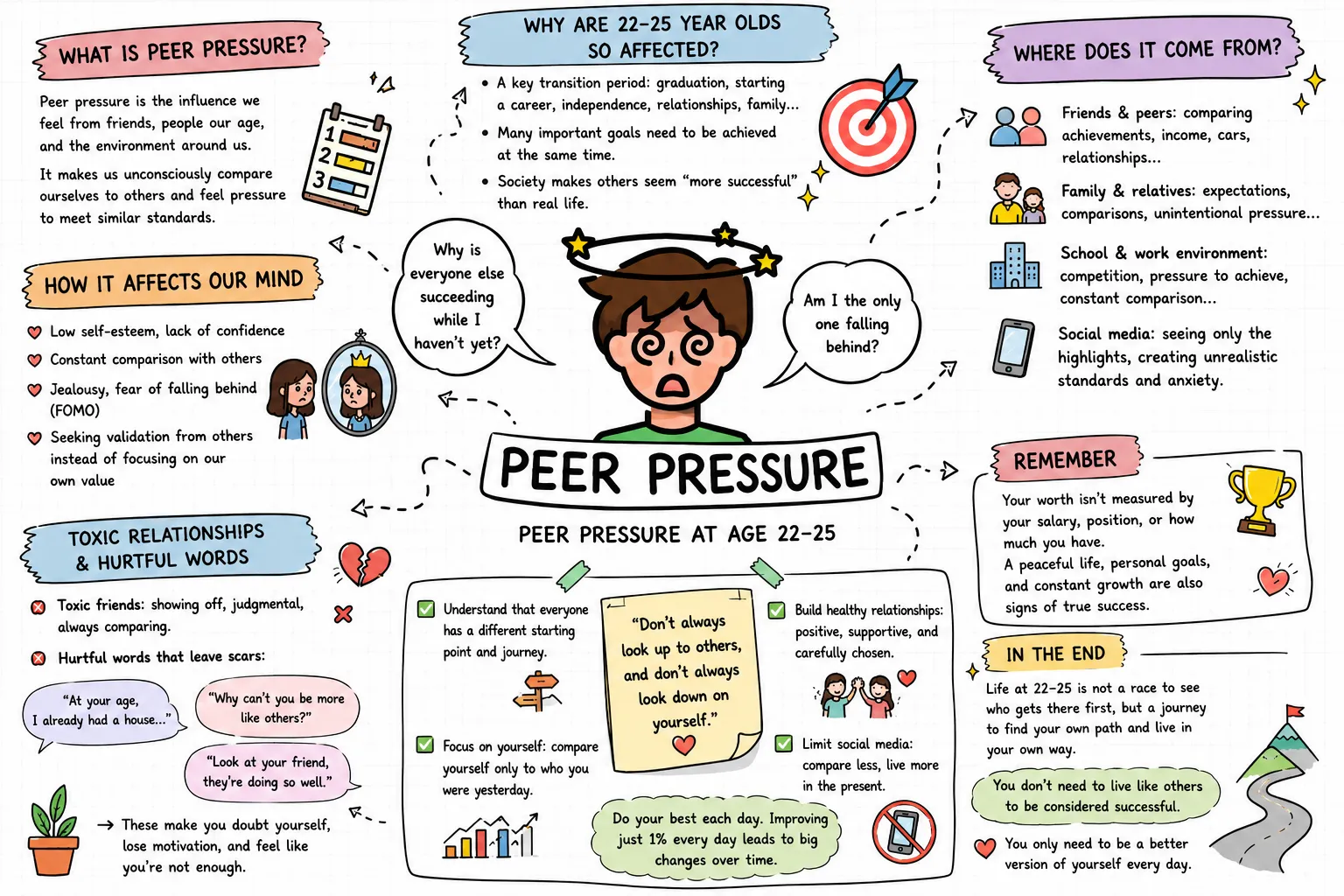
What is Peer Pressure? Why is the age of 22 - 25 easily affected?
Peer pressure is a state where a person is influenced by their peers, environment, or social group. This influence does not only come from direct urging but also from observing others' lives and unconsciously using them as a standard to evaluate oneself.
The age of 22 - 25 is often considered the middle stage of a person's life - a period no longer as immature as the early twenties, but not yet mature enough to be truly steady against all the fluctuations of life. This is the time when people begin to step out of their family's comfort zone, learn to make their own decisions for the future, take responsibility for their choices, and stand on their own two feet. However, “independence” at this age is often just the first step, because inside each person, there are still many unstable things: little life experience, unsolid finances, sometimes erratic emotions, and future orientations that are still in the process of sprouting.
Also for this reason, at this age, everyone is in a very different situation. Some are still struggling with their studies, working and studying at the same time, trying to finish their degree while looking for a suitable direction for themselves. Some have just graduated, carrying many expectations but also a lot of confusion when stepping into the labor market for the first time. Some have left school early to rush into society, make a living for themselves, start a career very early, and learn how to “earn their daily bread” with their own strength. There are also those who have started thinking about getting married, building a home, and carrying new responsibilities on their shoulders. It is this diversity that makes the age of 22 - 25 a period of both many opportunities and a lot of pressure, and young people can easily fall into the mentality of wanting to “be inferior to no one” when they see those around them seemingly moving faster than themselves.
Meanwhile, social media constantly displays images of salaries worth tens of millions, cars, houses, luxurious trips, or successful startup stories at a very young age. This makes many people unconsciously believe that this is the “normal standard” that everyone must achieve.
The causes that create peer pressure
Peer pressure does not appear naturally but is formed by many different factors.
Friends and peers. When seeing friends having good jobs, high incomes, buying cars, buying houses, or getting married, many people will start asking themselves: “Am I slower than them?”
Family and relatives. Many young people have heard phrases like: “Other people's children at your age are already managers”, “Your friend is already married!” or “When will you settle down?” Although stemming from care, those words sometimes unintentionally create enormous pressure.
There is also the study and work environment. A place that always emphasizes achievements, fierce competition, or constantly compares employees with each other will make people easily lose their sense of self-satisfaction.
Social media also becomes a “distorted mirror”. We often only see the best moments in others' lives but forget that behind every success there may be many failures, pressures, and things they do not share, because “who would show off their own bad things?”
How does personal psychology affect it?
Not everyone is affected by peer pressure in the same way. The most decisive factor is how each person perceives themselves.
People with low self-esteem or who are overly insecure easily assume they are inferior. Just seeing someone else achieve something, they immediately deny what they currently have. The habit of comparing oneself to others makes people fall into a negative loop. When others have more, we feel inferior; when others are more successful, we think we have failed.
Jealousy, the fear of missing out (FOMO), or constantly seeking external validation also make the pressure grow. Gradually, young people unconsciously stop living according to their own goals and begin chasing others' goals, implicitly assuming them to be a standard that must be achieved.
Toxic relationships and hurtful words
Not all relationships bring motivation.
There are friends who always show off their achievements to affirm themselves, always implicitly comparing or looking down on others. There are environments that only judge people by money, position, or status.
Sometimes, seemingly very normal words like:
“At your age, I had...”
“Why can they do it but you can't?”
“Look at your friend and learn from them.”
...turn into invisible cuts in the hearts of young people. Constant comparison makes them gradually lose faith in themselves, living with the feeling that they are never good enough, fast enough, or successful enough.
How to overcome peer pressure?
The first thing to understand is that everyone is born with a different starting point, circumstance, and journey. Do not use other people's lives as a measuring stick for your own. Instead of constantly looking up at others' successes, learn to look back at your own journey. There is a saying very much worth pondering: “Do not keep looking up to see yourself as inferior, nor keep your head down and forget that you are moving forward”. “Don't compare yourself with anyone in this world...if you do so, you are insulting yourself.” (Bill Gates - Founder of Microsoft).
Focus on what you can do today instead of what others have achieved. Making a little more progress each day than your yesterday's self is already a success worth cherishing. Besides, limit comparisons on social media, build positive relationships, know how to selectively accept feedback, and learn to say “no” to expectations that do not belong to you. Remember that a person's value is not determined by their salary, position, or whether they succeed early or late. A peaceful life, with goals and continuous development, is also a very proud success.