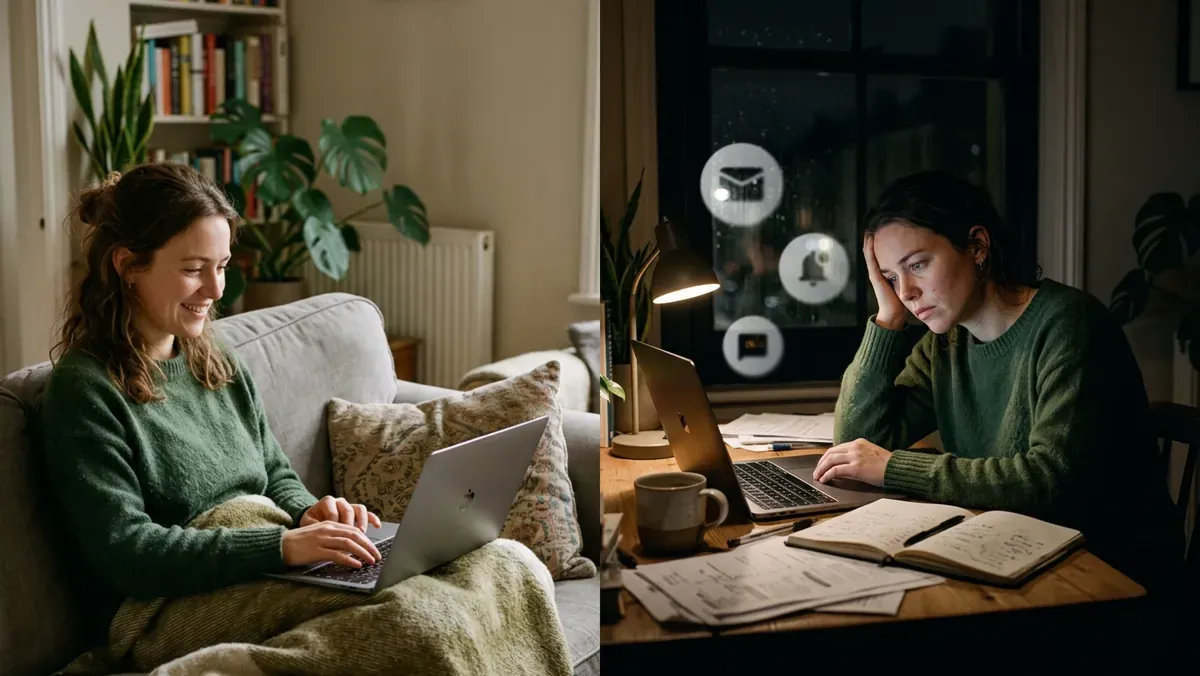

For the majority of workers, the concept of "remote work" evokes an ideal picture: no more crowded mornings stuck in traffic, no more pressure to wear office uniforms, and the freedom to choose a workspace, from a cozy dining table to a breezy café in an unfamiliar city.
Many real-world surveys have found that remote workers save between 62 and 90 minutes of commuting each day, equivalent to being given back half a month of working time each year. However, does this model truly provide the perfect balance, or is it simply replacing old office pressures with a new, more subtle and draining form of crisis?

When the physical boundary between the office and home is completely erased, the living space is unintentionally transformed into a permanent "workshop." Many remote employees admit that they fall into a state of always being available, constantly checking work messages even after working hours have ended.
The absence of the moment when you shut down your computer, walk out of the office, and commute home means that the brain receives no signal that "it is time to rest." This ambiguity leads workers to spend more hours working despite technically being at home, while facing fragmented workloads and a prolonged sense of chaos. As a result, the reported burnout rate among fully remote employees has reached 61%, surpassing that of both hybrid workers and those working directly in the office.
Working through technology platforms such as Slack, Teams, or Zoom helps maintain basic information flow, but it also completely strips away human-centered interactions. When every conversation has to be scheduled in advance or reduced to dry lines of text, organizations gradually lose their natural sense of connection. Spontaneous conversations by the coffee machine, shared lunches, or a reassuring pat on the shoulder from a colleague are all catalysts for building trust and relieving stress. Without nonverbal cues such as eye contact or tone of voice, misunderstandings can easily arise through text messages, turning minor issues into internal communication crises.
More seriously, remote work can also create a phenomenon known as "distance bias." Employees who do not appear physically at the office are often less visible to their superiors when it comes to important projects, causing their opportunities for promotion or access to mentorship to lag significantly behind those of their on-site colleagues. Remote workers have to make twice the effort to prove their value and presence, unintentionally placing another layer of psychological pressure on themselves.
Recent medical and sociological studies have pointed to a startling reality: working remotely three to five days a week significantly increases the risk of loneliness and anxiety. As many as 25% of remote employees admit to experiencing a pervasive sense of loneliness every day, considerably higher than the 16% reported by office workers. This isolation affects not only mood but also physical health. Spending an entire day without any direct human interaction causes an individual's world to become increasingly confined, increasing the risk of depression, particularly among young Gen Z individuals who live alone.
At the same time, working from home is a harsh test of one's self-management abilities. Without direct supervision from a manager, you are surrounded by countless sources of distraction, from household chores and children to entertainment devices.
Without a strong mindset and a strict discipline system to establish a serious schedule, workers can easily fall into one of two extremes: either becoming absorbed in procrastination, causing work to stagnate, or working without direction until they are exhausted, while their actual efficiency remains low.