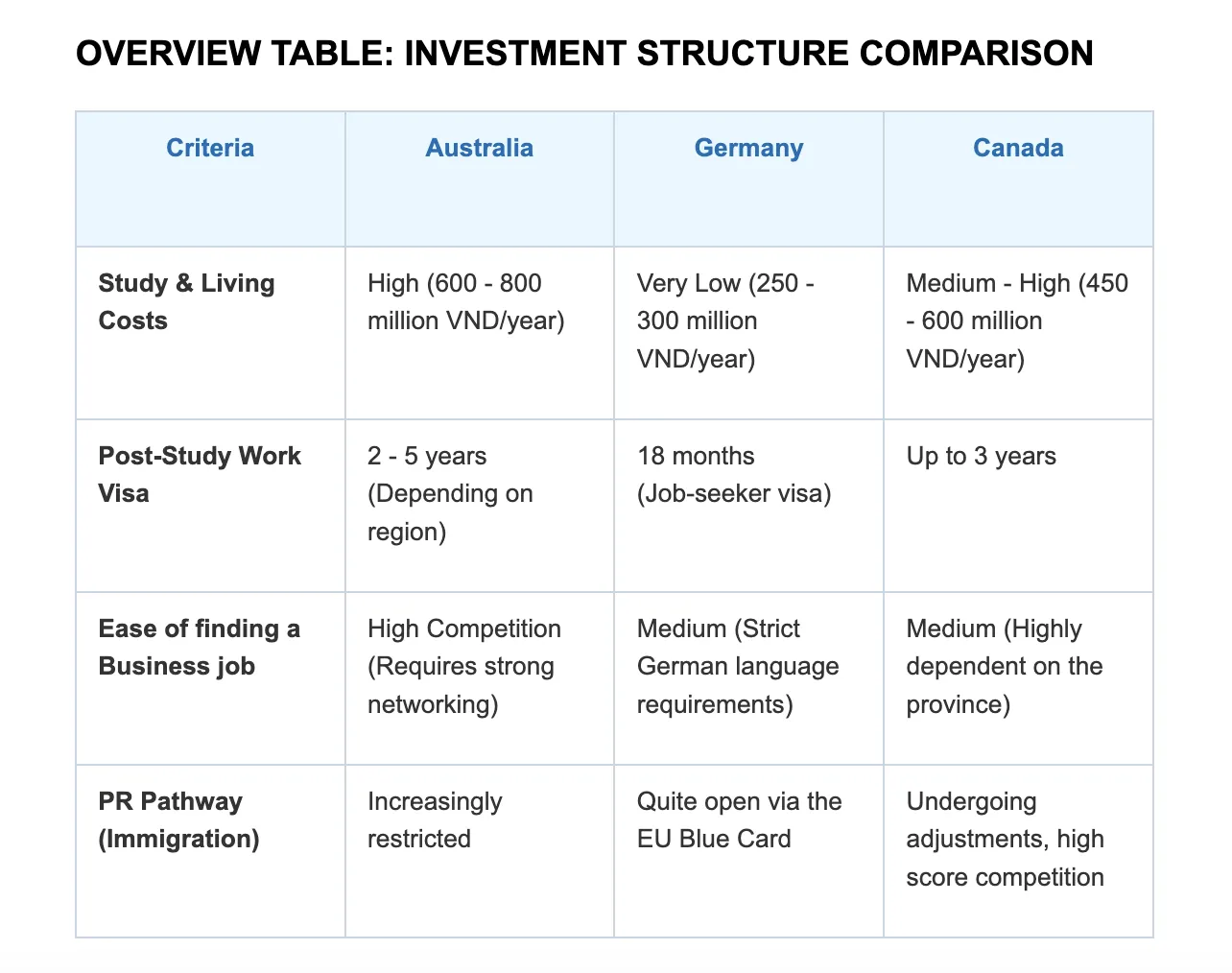

For students in Business and Management fields, a Master's degree is not just an educational upgrade; it is a "golden ticket" to optimize post-graduation employment and permanent residency (PR) opportunities abroad. Trending fields like Business Analytics, Supply Chain Management, and Digital Marketing are highly sought after in the global talent market.
However, the post-study work visa policies of major destination countries are undergoing significant shifts. The following article provides an in-depth analysis of three top destinations: Australia, Canada, and Germany, helping you find the most optimal choice for your Return on Investment (ROI).
1. Australia: Top-Tier Income Advantage, But Stricter "Rules of the Game"
Australia has traditionally been a highly attractive destination for Business students due to its dynamic economy and one of the highest minimum wages in the world.
Key Advantages:
Post-Study Work Visa (Subclass 485): Students who complete a Master's by Coursework can stay and work for 2 to 3 years. If studying in Regional areas (outside Sydney, Melbourne, and Brisbane), this period can be extended up to 4 to 5 years.
Broad Job Market: Fields such as Finance, Accounting, and especially Business Analytics consistently appear on the Skilled Occupation List.
Hidden Challenges to Consider:
Since 2024, Australia has begun tightening its student visa regulations, requiring higher financial proof and stricter English proficiency scores. The high cost of living in major cities also presents a significant financial burden.
2. Germany: Zero Tuition Fees and a Red Carpet for Knowledge Workers
If you are highly independent and want to optimize your study costs, Germany is a "hidden gem." Facing an aging population and severe labor shortages, the country is significantly loosening its policies to retain international talent.
Key Advantages:
100% Tuition Fee Exemption: The vast majority of public universities in Germany (including English-taught Master's programs) are tuition-free. Students only need to pay a semester contribution fee of around 200 - 300 EUR per semester.
18-Month Job-Seeker Visa: Immediately after graduation, you are granted an 18-month visa to look for employment related to your field of study.
Fast-Track PR Pathway: With an EU Blue Card designed for highly skilled workers, you have the opportunity to apply for Permanent Residency (PR) after just 21 to 33 months of working.
Hidden Challenges to Consider:
The biggest barrier is the Language. Even if you study in English, having a grasp of the German language (at least B1/B2 level) is mandatory to smoothly integrate into the corporate culture and secure jobs at local companies.
3. Canada: The Land of Diversity, But Requires a Smarter Strategy
Canada was once considered the "easiest" country for post-graduation immigration. However, facing pressures from housing shortages and inflation, the Canadian government is actively making adjustments.
Key Advantages:
Post-Graduation Work Permit (PGWP): Master's degree graduates (whether from a 1-year or 2-year program) are currently prioritized for a PGWP of up to 3 years.
Clear Express Entry System: A Master's degree yields very high points in the Comprehensive Ranking System (CRS), especially if you possess French language proficiency (alongside English).
Hidden Challenges to Consider:
Competition for PR applications is becoming increasingly fierce, and the CRS draw scores for Express Entry are currently very high. Business applicants need to focus on Provincial Nominee Programs (PNPs) rather than crowding into Ontario or British Columbia.