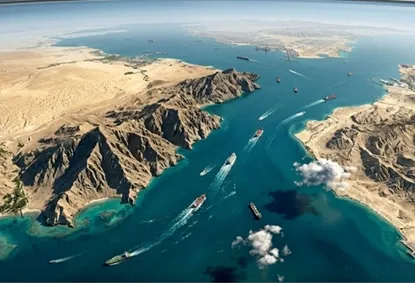

In the brutal geopolitical chess game of the 21st century, the question "Who controls the Strait of Hormuz will control the world?" is no longer a far-fetched hypothesis, but has truly become a glaring reality. Nestled between the Persian Gulf and the Gulf of Oman, this narrow strip of water has transcended the definition of a conventional maritime route to rise as the "global energy switch." The survival of brilliant industries from East to West, the heartbeat of tens of thousands of factories, and the continuous operation of the international supply chain, all are holding their breath, dependent on the streams of black gold slowly flowing through this tiny strategic chokepoint.
The power picture at Hormuz has been depicted more sharply and starkly than ever through the landmark upheavals of 2026. Instead of bogging down in ostentatious firepower confrontations, Iran has showcased a cunning and calculated art of geopolitical manipulation. They began with lightning-fast blockade moves, enough to send a chill down the global spine, only to crack the route open immediately after, but accompanied by stringent conditions. Most audaciously, the demand to impose "transit fees" on mammoth oil tankers passing through these waters has transformed Hormuz from a free route into an exclusive geopolitical toll booth, where the concessions of the international community are measured in barrels of crude oil.
From these very strategic steps, an entirely new power mechanism has been born, redefining the roots of national power. In the modern era, dominating the world does not necessarily require bloody military victories or the massive presence of oceanic fleets. The ultimate weapon is now much more streamlined and terrifying: merely the ability to "close" or "open" a single chokepoint. Just a move threatening to tighten the route is enough to ignite oil prices to unprecedented peaks, instantly suffocating the economies of opposing nations. Conversely, a declaration to loosen traffic can quickly crash oil prices, depleting the revenue streams of competitors. Absolute power now lies in the ability to manipulate the scarcity and expectations of all humanity.
The consequences of this game of thrones at Hormuz do not merely linger around the Middle East but have created seismic waves shaking the entire global economic structure. The electronic boards at financial centers from Wall Street to London no longer reflect pure economic laws of supply and demand, but continuously jerk and fluctuate intensely with every breath and political decision from this distant strait. While investors reel in a storm of speculation, energy-importing nations expose their vulnerability and desperate dependence. Their energy security, and more broadly their national security, is essentially being held hostage on ships drifting through these highly uncertain waters.
This tectonic shift in the balance of power forces the global elite to bitterly acknowledge a core truth: the nature of energy power has completely changed. Supreme power no longer rests entirely in the hands of nations possessing colossal reserves or the world's leading extraction capacities. Pumping oil out of the ground is only half the story; the other half, more vital and decisive to the situation, is controlling its flow. In a hyper-connected yet logistically fragile world, the one holding the key to maritime "bottlenecks" is the one grasping the hilt of the sword that shapes the world order.
The Strait of Hormuz has truly transcended a mere geographical entity to metamorphose into an absolute symbol of power in the new era. It operates no differently than an "ON/OFF switch" for the global economy. Whichever hand holds the power to flip that switch will not only determine the value of every drop of energy oil but also directly manipulate the prosperity or collapse of the entire financial system and contemporary civilization.