Uncategorized
Fire and explosion prevention measures forhouseholds

Fire and explosion prevention measures forhouseholds
Every year, fires and explosions in residential areas across the countrycause significant damage to life and property. The primary causes of thisreality stem from unsafe electricity and gas usage in many families, particularly as the demand for electricity continues to surge. Seeminglysimple oversights, such as leaving burning incense, candles, or votivepapers unsupervised, overloading electrical devices, or makingunauthorized power connections, can lead to fires. In this article, we share 15 fire and explosion prevention measures for
households, with the hope of helping to protect your family.
Do not keep large amounts of flammable items or goods near cookingareas. Do not store gasoline, oil, gas, explosive gases, or flammableliquids inside the house. If storage is absolutely necessary, keeponlyaminimal amount in a separate area to avoid confusion and spillage. Automatic circuit breakers (safety switches) must be installed for themain electrical system of the house, as well as for each floor, eachbranch, and specifically for high-power appliances. Do not place flammablegoods near light bulbs (wires, sockets, devices) or close to walls, floors, ceilings, and partitions made of combustible materials. Irons, electric stoves, and dryers must be supervised when in use. Donot
allow small children, the elderly with poor vision, people with disabilities, or those with mental conditions to operate electrical appliances. Regularly inspect cooking areas and worship (altar) areas; turnoff
unnecessary electrical devices.
Do not install iron cages or meshes on the balconies of high-rise buildings. If they are already installed, they must include an internal latch door that
is never locked. Keep ladders or rope ladders ready for escape in caseof
fire. Emergency Action: When a fire occurs, use every means possibletoquickly alert people around you. Call the Fire and Rescue Police at 114or
the nearest local civil defense team or police station immediately. Simultaneously, use available tools to fight the fire and evacuateaccording to the planned scenario.
households, with the hope of helping to protect your family.
Do not keep large amounts of flammable items or goods near cookingareas. Do not store gasoline, oil, gas, explosive gases, or flammableliquids inside the house. If storage is absolutely necessary, keeponlyaminimal amount in a separate area to avoid confusion and spillage. Automatic circuit breakers (safety switches) must be installed for themain electrical system of the house, as well as for each floor, eachbranch, and specifically for high-power appliances. Do not place flammablegoods near light bulbs (wires, sockets, devices) or close to walls, floors, ceilings, and partitions made of combustible materials. Irons, electric stoves, and dryers must be supervised when in use. Donot
allow small children, the elderly with poor vision, people with disabilities, or those with mental conditions to operate electrical appliances. Regularly inspect cooking areas and worship (altar) areas; turnoff
unnecessary electrical devices.
Do not install iron cages or meshes on the balconies of high-rise buildings. If they are already installed, they must include an internal latch door that
is never locked. Keep ladders or rope ladders ready for escape in caseof
fire. Emergency Action: When a fire occurs, use every means possibletoquickly alert people around you. Call the Fire and Rescue Police at 114or
the nearest local civil defense team or police station immediately. Simultaneously, use available tools to fight the fire and evacuateaccording to the planned scenario.
Essential fire prevention and fighting equipment foreveryfamily
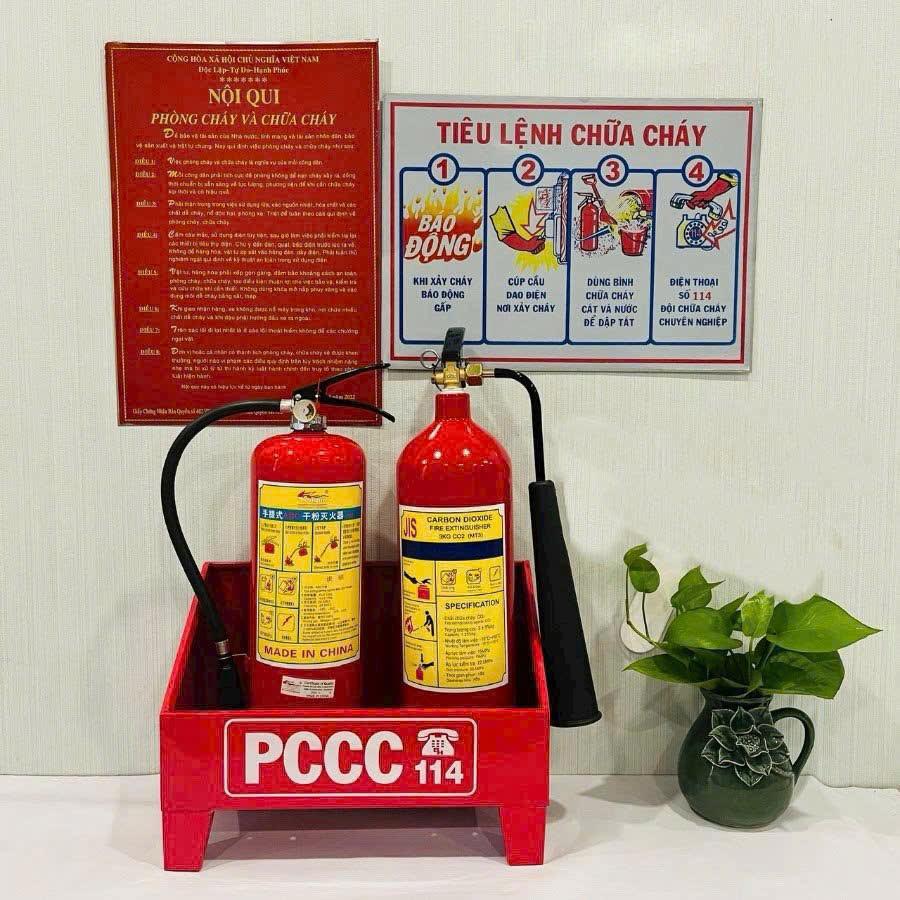
Fire extinguishers are easy-to-use and highly effective devices. Theycome in various capacities and shapes. However, note that some types areonly suitable for diluting fires or fighting indoor fires; they cannot "treat"fires caused by alkali metals or alkaline earth metals, as these mayreact
and burn more intensely. Families should place fire extinguishers in visible, dry locations, avoidingdirect sunlight. Handle them gently when moving and inspect themregularly.
and burn more intensely. Families should place fire extinguishers in visible, dry locations, avoidingdirect sunlight. Handle them gently when moving and inspect themregularly.
Escape Rope Ladders In cases where you cannot exit through the maindoor or emergency exit during a fire, a rope ladder or escape rope is anextremely useful tool to help you escape via a window or balcony. Depending on the height of the house, you can choose escape ropes of
corresponding lengths (e.g., a 50m rope is equivalent to a 12-storybuilding). In an emergency, hook the ladder end to a windowframeor abalcony with a solid base. All parts of the device are fire-resistant, soyoucan remain calm and escape safely. The allowable load capacityof therope is approximately 150kg.
corresponding lengths (e.g., a 50m rope is equivalent to a 12-storybuilding). In an emergency, hook the ladder end to a windowframeor abalcony with a solid base. All parts of the device are fire-resistant, soyoucan remain calm and escape safely. The allowable load capacityof therope is approximately 150kg.

Fire Blankets Fire blankets (also known as fire suppression blankets) aremade from fiberglass and do not use toxic asbestos. These blankets are heat-insulating, fire-resistant, and resistant toacidsand alkalis; notably, they can withstand temperatures up to 700 degreesCelsius. When a fire occurs, simply wrap the blanket around your bodyand quickly move towards the emergency stairs to escape the fire zoneinbuildings, offices, warehouses, etc. Specialized DemolitionToolsSpecialized demolition tool kits are suitable for use in houses, villas, apartments, warehouses, etc. In the event of an incident, you can usethiskit to break through barriers and reach a safe location.