
Over the past decade, web-based and app-based connection platforms (often generically referred to as “dating apps”) have evolved from a niche market into a global ecosystem. However, a popular stereotype persists: that these platforms primarily serve short-term, superficial relationships. Recent empirical data, including sociological studies and user behavior analyses, is beginning to strongly refute this notion. A new picture is emerging, showing that digital spaces for Online Connections are not just places to seek serious romance, but also powerful tools for expanding social networks and building high-quality connections.

Recent empirical data, including sociological studies and user behavior analyses, is beginning to strongly refute this notion. A new picture is emerging, showing that digital spaces are not just places to seek serious romance, but also powerful tools for expanding social networks and building high-quality connections.
Challenging Stereotypes About Quality of Online Connections
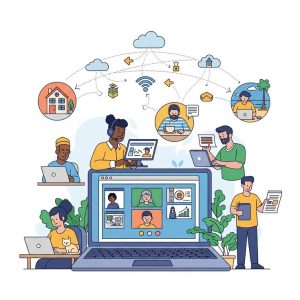
One of the most severe criticisms against online connection is that it diminishes the quality and commitment level of relationships. However, data from diverse cultural contexts is suggests the opposite.
A study published in the journal PLOS ONE, focusing on couples in Switzerland, provided surprising findings.
When comparing couples who met through apps and web platforms with those who met offline, researchers discovered a distinct difference in intention: Couples formed online actually had a higher intention to cohabit compared to the traditionally met group. This indicates a clear long-term stability seeking dynamic from these users of Online Connections..
Contrary to the assumption that online relationships would be less sustainable, the study indicated that relationship satisfaction levels were equivalent between the two groups. This finding is further reinforced by a synthesis by Psyezmedia, which concluded that there was no significant difference in core relationship indicators (including satisfaction, intimacy, and trust) between couples who started online and offline.
This data affirms that modern digital platforms are not environments that degrade emotional quality. Instead, they offer a ‘level playing field’ in the potential for building deep and sustainable Online Connections.
The Shift from “Swiping” to “Architecting”
Another misconception is that using these platforms merely fosters a passive and superficial connection. However, the latest academic research reveals a much more complex and intentional picture of how users interact with the digital space for Online Connections.
A 2025 study by Fan Zhang and Yun Chen conducted in-depth interviews with 20 college-educated users about how they construct their profiles. The results showed that users are not passive; they are active “architects” of their personal image: “Users are very strategic: selecting photos that reflect personality and interests, and withholding private information to boost confidence and safety.”
This strategic behavior is not aimed at attracting everyone, but at attracting the right person. By investing time in showcasing interests and personality, users are signaling that they are seeking compatibility and a quality Online Connection, rather than just a random match
This is particularly relevant for web-based platforms, where profile space is often more detailed than on mobile apps. Users are taking these tools seriously for self-expression and screening, underscoring the maturation of the online connection ecosystem.
Beyond the Romantic Boundary
Focusing solely on “dating” overlooks a crucial social function that these platforms are fulfilling: Social Network Expansion through Online Connections.
In Vietnam, a rapidly developing market, a 2021 survey by Decision Lab showed a staggering penetration rate: 65% of surveyed participants had used at least one dating app.
However, their motivation is not limited to romance. A very high proportion of users (48%) stated they use these platforms for the purpose of expanding their relationships and Online Connections (making new friends, connecting).
This shows a fundamental shift. These apps and websites are evolving into community-connecting tools, helping users access new individuals they might struggle to meet within their closed social circles (family, work, school). In the context of globalization, the potential of web platforms designed for cross-border friendship becomes particularly clear. They serve not only romantic needs but also act as bridges for cultural exchange and international social networking.
A New Social Infrastructure
The synthesized data from empirical studies and market analysis clearly shows: Online connection platforms have matured. They have moved past the phase of being viewed as mere tools for short-term interactions.
Three main pillars underpin this change: Quality, Intentionality, and Community within the domain of Online Connections.
- Quality: Relationships formed online have an equivalent level of satisfaction and commitment (and even a higher intention for cohabitation) compared to traditional relationships.
- Intentionality: Users are increasingly strategic and serious in profile construction, signaling a desire for deep compatibility.
- Community: The function of these platforms has significantly expanded beyond romance, becoming an essential tool for making friends and expanding social networks.
For developers and society alike, it is time to view these platforms, from mobile apps to global connection websites, as critical social infrastructure capable of fostering quality, diverse, and sustainable Online Connections in the future.
Related Posts:
7 Bí Quyết Tuyệt Vời để Kết Bạn Mới Khi Trưởng Thành (Kể Cả Hướng Nội)