
Ho Chi Minh City’s inaugural land price list, set to take effect early next year, shows price increases across most areas, though unevenly. The former Binh Duong area records the sharpest rises, with some locations seeing prices surge by more than eight times the current level.
At a meeting on the afternoon of December 26, the Ho Chi Minh City People’s Council passed a resolution promulgating the city’s first unified land price list, applicable from January 1, 2026. The list will apply citywide following the administrative merger of Ho Chi Minh City, Binh Duong, and Ba Ria – Vung Tau. It is developed in accordance with the 2024 Land Law and adjusted based on market principles, replacing the existing land price lists that remain valid until the end of 2025.
Overall, residential land prices have increased in most areas compared to the pre-merger price lists of the three localities, though the scale of adjustment varies significantly. Central districts of the former Ho Chi Minh City show only modest increases, while fast-growing urban areas in Binh Duong and Ba Ria – Vung Tau experience much stronger upward adjustments.
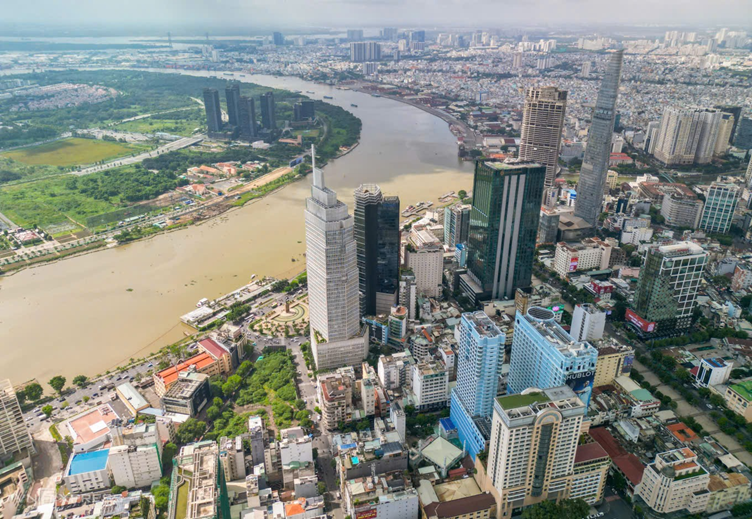
(Real estate in central Ho Chi Minh City, July 2025. Photo: Quynh Tran)
In the former Ho Chi Minh City area, residential land prices were revised with coefficients ranging from 1 to 1.65 times the 2024 price list. The highest price reaches approximately VND 687 million per square meter on central streets such as Dong Khoi, Nguyen Hue, and Le Loi, remaining almost unchanged from the currently applied list. The lowest price is around VND 2.3 million per square meter in the Thieng Lieng residential area.
According to the new list, aside from a few specific routes where prices rise by up to 1.65 times, the overall picture in the former Ho Chi Minh City area is relatively flat, with increases of only about 2%. In some locations, prices for production land even decrease in order to encourage investment.
The Ho Chi Minh City People’s Committee explained that price increases in this area are limited because land prices have already been adjusted closer to market levels in recent years. Maintaining a moderate adjustment is intended to minimize impacts on living costs, residents’ financial obligations, and production and business activities in the city’s urban core.
In contrast, the former Binh Duong area records the highest land price increases among the three pre-merger localities. Residential land prices here rise by coefficients ranging from 1 to 8.077 times compared to the 2024 list.
The most notable case is DH.505 Road, on the section from Le Trang Bridge to DH.507. Residential land prices on this route increased from VND 780,000 to VND 6.3 million per square meter – an increase of more than eight times. Commercial and service land prices on the same route rose by about four times, while production and business land prices increased nearly 3.8 times.
The highest absolute land price in the former Binh Duong area after adjustment reaches approximately VND 89.6 million per square meter (up from VND 52.16 million), concentrated on central streets such as Doctor Yersin and Bach Dang. Although still far lower than prices in central Ho Chi Minh City, this marks a significant adjustment compared to the previous list.
According to the Ho Chi Minh City People’s Committee, the main reason for this sharp increase is that Binh Duong’s pre-merger land price list lagged far behind actual market prices. Surveys showed that in some locations, real transaction prices were more than 13 times higher than the listed prices, creating major difficulties in compensation and the calculation of financial obligations.
Meanwhile, land prices in the former Ho Chi Minh City area had already undergone multiple adjustments in recent years, leaving limited room for further increases.
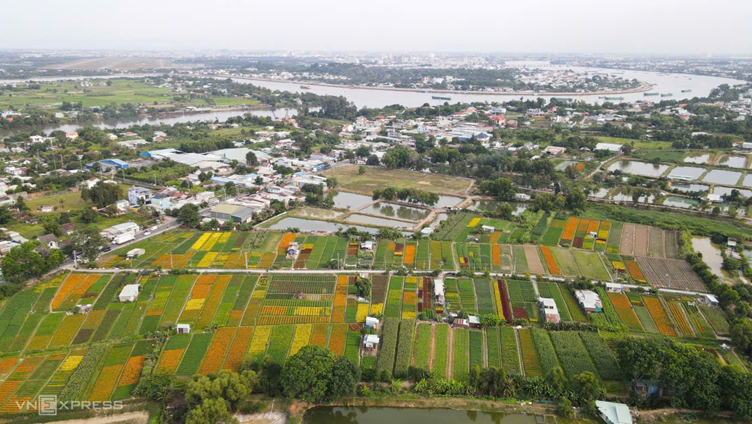
(Tan Ba Flower Village, Binh Duong area. Photo: Phuoc Tuan)
In the former Ba Ria – Vung Tau area (designated Area III in the new list), residential land prices also rise sharply compared to the current list, with coefficients ranging from about 1.7 to over four times, though the increase is less dramatic than in former Binh Duong.
Under the approved list, the highest residential land price in this area reaches VND 149.48 million per square meter, applied to central coastal roads in Vung Tau City, particularly Thuy Van Street. This is a key tourism and service corridor, densely lined with hotels, resorts, and commercial establishments.
The lowest residential land prices in the former Ba Ria – Vung Tau area are only a few million VND per square meter, mainly in remote communes, rural areas, or locations with incomplete technical infrastructure. These levels are significantly lower than central Vung Tau and also below many urban areas in former Binh Duong.
The Ho Chi Minh City People’s Committee noted that land price adjustments in the Vung Tau area aim to narrow the gap between State-regulated prices and actual market transactions, especially in coastal zones where prices have risen rapidly in recent years. However, since pre-merger land prices in this locality were already at a medium-to-high level, the adjustment is not as abrupt as in former Binh Duong.
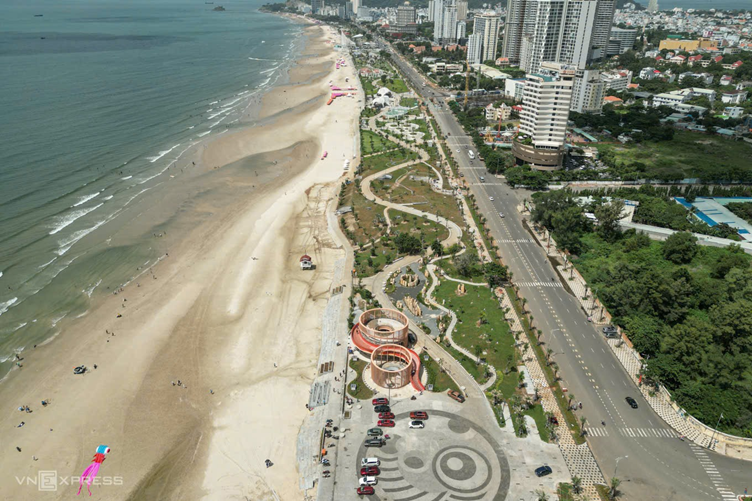
(Back Beach Park, Vung Tau City. Photo: Truong Ha)
A notable feature of the inaugural land price list is the revision of agricultural land prices. In the initial draft, agricultural land was priced using the income method based on farming profits, resulting in very low values and, in some cases, sharp declines compared to the previous list.
After review, the Ho Chi Minh City People’s Committee submitted a supplementary proposal to raise agricultural land prices to better protect land users’ rights, particularly in cases of State land recovery. Accordingly, the price of annual crop land in the former Ho Chi Minh City area is set at VND 1.2 million per square meter, and VND 1 million per square meter in former Binh Duong. Prices for perennial crop land are VND 1.44 million and VND 1.2 million per square meter, respectively.
The new land price list will have wide-ranging impacts. For residents, the most significant benefit is higher compensation when land is recovered by the State, bringing payments closer to market values. On the other hand, financial obligations – such as fees for first-time issuance of land use right certificates, land-use purpose conversion, and land-related taxes and charges – will increase.
Real estate developers are less directly affected in large projects, as land-use fees are typically calculated using the surplus method. However, manufacturing, commercial, and service enterprises leasing land with annual payments may face higher costs in areas experiencing sharp price increases.
For the State budget, the new price list is expected to boost revenue from land-use fees, land rents, and related taxes, while simultaneously raising compensation and site clearance costs for public investment projects.
The Ho Chi Minh City People’s Committee stated that in subsequent years, the land price list will be reviewed and adjusted annually in accordance with regulations to better reflect market fluctuations.
VnExpress