
Throughout the week, the U.S. has moved a large number of special operations aircraft, along with numerous transport planes carrying troops and equipment, into the Caribbean, providing Washington with additional military options in the region.
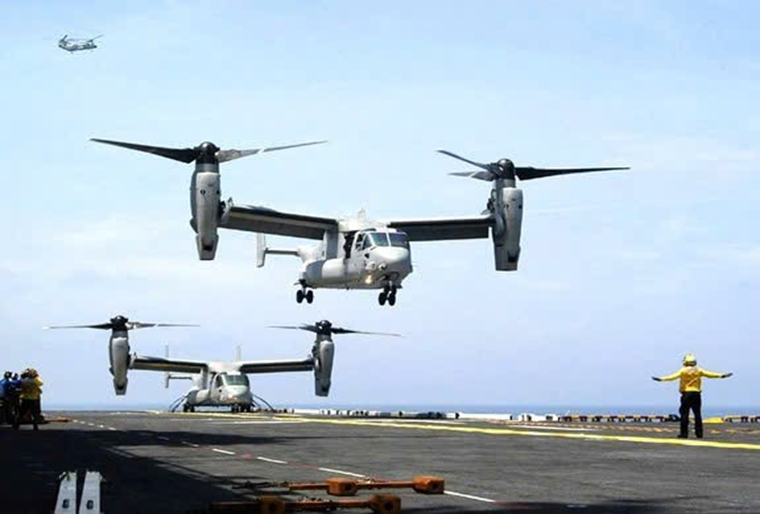
(U.S. CV-22 Osprey tiltrotor aircraft. Photo: U.S. Air Force)
This information was reported by The Wall Street Journal on December 23, citing U.S. officials and open-source flight-tracking data.
In recent days, President Trump has stepped up pressure on the administration of Venezuelan President Nicolás Maduro, ordering a blockade of oil tankers entering and leaving the country. Mr. Trump declared that the airspace surrounding Venezuela should be considered “closed” and did not rule out the possibility of carrying out airstrikes against the country.
“We have assembled a massive force, the largest ever, and the largest ever in South America,” the U.S. president said on December 22. “We will soon deploy a similar operation on land,” he added.
Specifically, at least 10 CV-22 Osprey tiltrotor aircraft, which are used by U.S. special operations forces, flew into the region on the evening of December 22 (local time) from Cannon Air Force Base in New Mexico, according to an official.
On the same day, C-17 transport aircraft from Fort Stewart in Georgia and Fort Campbell, located on the border between Kentucky and Tennessee, arrived in Puerto Rico, according to flight-tracking data. Another U.S. official confirmed that military personnel and equipment were transported aboard these aircraft.
It remains unclear what types of troops or military equipment were carried on the planes. Cannon Air Force Base is home to the 27th Special Operations Wing, while the 160th Special Operations Aviation Regiment, an elite U.S. special operations unit, and the 101st Airborne Division are based at Fort Campbell. The 1st Battalion of the 75th Ranger Regiment is stationed at Hunter Army Airfield, part of Fort Stewart.
The 27th Special Operations Wing and the 160th Special Operations Aviation Regiment are trained to support high-risk infiltration and exfiltration missions, providing close air support and combat aviation support. Army Rangers are trained to seize airfields and provide security for special operations forces such as SEAL Team 6 or Delta Force during kill-or-capture missions.
“They are positioning forces in preparation for action,” The Wall Street Journal quoted David Deptula, a retired U.S. Air Force lieutenant general and current dean of the Mitchell Institute for Aerospace Studies in Virginia, as saying.
According to him, the movement and positioning of military assets indicate that the Washington administration has decided on a course of action. “The remaining question is, what is this action intended to achieve?” Mr. Deptula posited.
Thanh Nien Newspaper